
Events Ascame/ March 13, 2026/ Featured, Trends
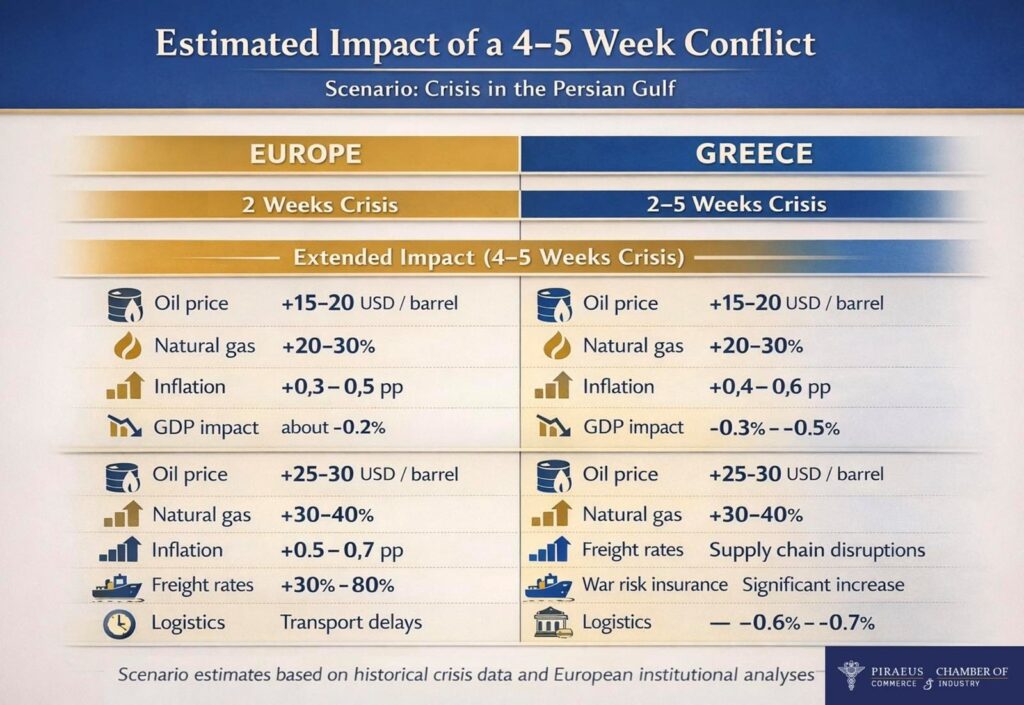
A war in the Middle East always results in serious and multi-level economic impacts, both regionally and globally. Previous generalized war tensions have created shocks in the global economy, as they reduced global GDP from -0.2% to -1%, increased inflation +1% and interest rates, and reduced investment to avoid risk. In the Eurozone, the losses after a month can reach $250 billion just from the increase in energy prices, an increase in inflation by 1.1%, and a GDP decline by 0.6%. Maritime transport, energy and the cost of global trade are the three main “parameters” that will determine, at an international level, the picture of the markets, at a time of extremely turbulent international relations with the European economy trying to stabilize in the midst of an international economic tariff war and, now, in the midst of yet another “regional conflict” in the horseshoe of the Eastern Mediterranean and the Near East.
For Greece, the most significant impacts are focused on five main sectors: energy costs, trade, shipping, tourism, and the financial market. In tourism, the country may be considered to be a “neighboring zone of instability”, especially by visitors from third countries such as the US and Asia, with possible cancellations of cruises and multi-destination packages, increased insurance coverage and a burden on the tourist image, especially on islands and areas of the Eastern Mediterranean. The total cost according to the scenario of more than 4-5 weeks will range from 2.1-2.6 billion euros, without taking into account today’s losses on the Greek stock market, which reached 14 billion euros in three sessions.
In shipping, possible attacks or blockages in the Strait of Hormuz and the Red Sea could lead to increased freight rates and war risk insurance premiums, rerouting of ships via the Cape of Good Hope, delays and reduced reliability of logistics, resulting in higher operating costs and pressures on charter In shipping, possible attacks or blockages in the Strait of Hormuz and the Red Sea could lead to increased freight rates and war risk insurance premiums, rerouting of ships via the Cape of Good Hope, delays and reduced reliability of logistics, resulting in higher operating costs and pressures on charter rates for Greek-owned companies.
According to the Ministry of Shipping, 325 Greek‑owned vessels are currently operating in the Persian Gulf region, while another 265 are approaching the Arabian Sea from the Red Sea and the Gulf of Oman. Ten of these ships fly the Greek flag, with at least 85 Greek sailors on board. Four vessels have already been hit, including one of Greek interest. Greek‑owned companies control more than 30% of the world’s oil tanker fleet. In addition, around 200,000 loaded containers and another 150,000 empty ones are stranded in the Red Sea and the Arabian Sea, creating significant gaps in the global container network.
Skytek data platform reports that 450 tankers and LNG ships, which are almost 10% of the world fleet, 170 container ships and 200 bulk carriers are trapped in the Strait of Hormuz. The passage has been banned for ships from the US, Israel and Europe. The daily passage before the ban had decreased by 70% from 120 ships to 40 per day. 3,000 ships pass through the Strait every month, 1/3 of the world’s seaborne oil, 1/5 of the world’s LNG. Alternative supply routes are 5 million barrels per day via Saudi Arabia’s Red Sea pipelines, another 1.5 million from the UAE and Iraq in the Mediterranean, which do not make up for the 17 million barrels through the Strait of Hormuz.
The effects of the new conflict and the disruption of cargo flows will be "experienced" by the ports of the Eastern Mediterranean and the port of Piraeus, which, as it is known, has lost a large part of its traffic due to the situation in the Red Sea and the African cruise
The disruption of trade and imports, especially through the Suez Canal, is likely to have a further impact on the supply chain, manufacturing and retail, as imports of raw materials, grains and petrochemicals are directly affected, increasing the cost of imports of energy, raw materials and technological products, creating insecurity in exports to countries in the Middle East and North Africa. Once again, the effects of the new conflict and the disruption of cargo flows will be “experienced” by the ports of the Eastern Mediterranean and the port of Piraeus, which, as it is known, has lost a large part of its traffic due to the situation in the Red Sea and the African cruise.
The large container shipping companies, “foreseeing” the situation, “rejected” plans to transit through Suez and have already imposed a surcharge of $ 1,500 – 2,500/TEU. At the same time, the rise in oil and natural gas prices, as a result of the market reaction to the closure of the Strait of Hormuz, through which approximately 20% of the world’s oil passes, will directly burden transportation, production costs and electricity prices, reinforcing inflationary pressures, especially in food and energy. The disruption of energy flows, as long as the conflict lasts, reinforces estimates for a short-term price of more than $ 80 per barrel, burdening the cost of fuel for transportation, production and heating, especially in the EU, which will restore inflationary pressures.
At the international level, financial markets are accustomed to reacting with a fall in stocks and bonds and then upward corrections, while gold and the dollar are rising as safe shelters and emerging market currencies are falling. Trends in reduced investment, a decline in tourism and exports, restrictions on oil flows and even reverse migration are also expected, as the cost of military surveillance increases.
At a geopolitical level, Greece is called upon to protect Cyprus and maintain balances between the US, Israel and Arab countries, while its role as an energy and geopolitical hub is strengthened with a possible increase in military surveillance in Crete and Cyprus
At a geopolitical level, Greece is called upon to protect Cyprus and maintain balances between the US, Israel and Arab countries, while its role as an energy and geopolitical hub is strengthened with a possible increase in military surveillance in Crete and Cyprus. The presence and involvement of the US leads us more to the scenario of a 4–5-week war period. In addition, tourism will be affected, since this is a sensitive sector in terms of “security perception”, since tourists from the US and Asia classify the entire Eastern Mediterranean in the same geographical area and in a “neighboring zone of instability” with the Middle East.
In addition to Europe, vulnerable countries are those of South and Southeast Asia, which are highly dependent on supplies from Persian Gulf countries, such as India (60%), Pakistan (99%), Bangladesh (72%), as well as Taiwan, South Korea, and Japan, with a 4-week supply. Also, China imports 80% of Iranian oil, depends on 30-40% on Persian Gulf oil and natural gas, and is already preparing orders for crude oil from Russia and the Atlantic to maintain its reserves. The main issue in all scenarios of economic impacts is once again the duration and spread of the war.
This opinion article has been written by Mr. Vassilis Korkidis, President of ASCAME’s member, the Piraeus Chamber of Commerce and Industry.