
Events Ascame/ March 31, 2026/ Trends
The Persian Gulf is undergoing a profound economic transformation that is reshaping global trade dynamics, and the Mediterranean region is directly affected. As highlighted by Mr. Vassilis Korkidis, President of the Piraeus Chamber of Commerce and Industry, “the non-energy exports of the Persian Gulf constitute another critical factor of instability for the global economy and have become a central pillar of the region’s economic diversification”. He adds: “The dependence of the international market on products such as fertilizers, chemicals and industrial materials makes the region not only an energy, but also a commercial hub. The escalation of conflicts in the Middle East increases transport costs, strengthens inflationary pressures and tests the resilience of supply chains. For Europe, Med countries and Greece, the answer can only be the strategic diversification of suppliers, strengthening logistics and the active role of shipping. In this new environment, economic resilience will be determined by the ability to adapt and the creation of strong international partnerships”.
A New Export Powerhouse Beyond Energy
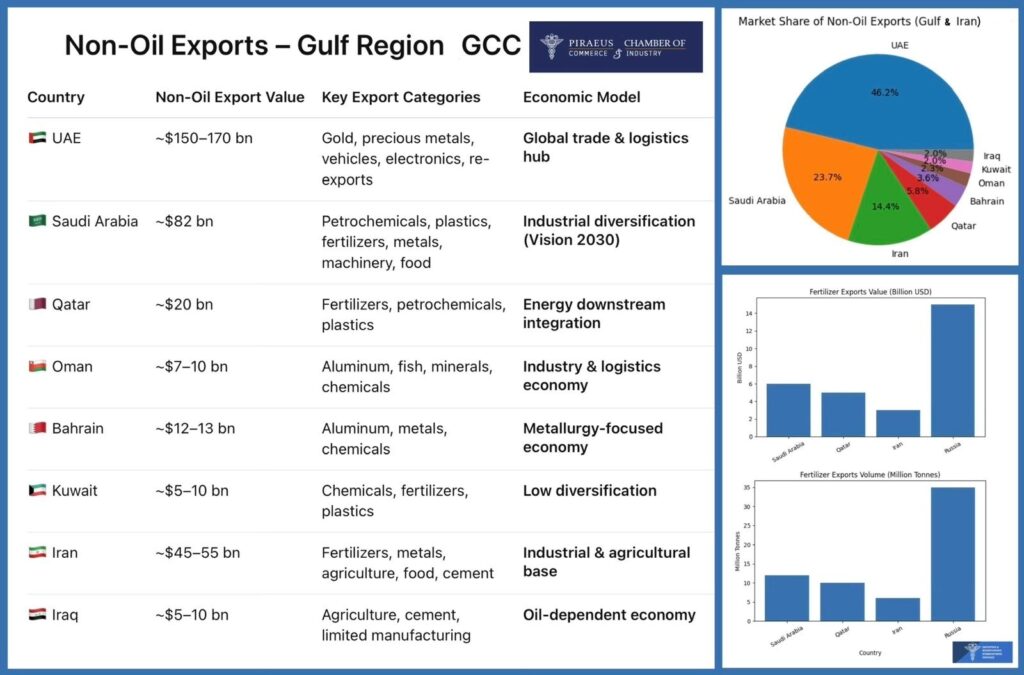
In recent years, Gulf economies have accelerated their shift from oil-dependent models to diversified export systems. According to the data referenced in the position paper, non-energy exports from GCC countries, together with Iran and Iraq, now reach $350–370 billion annually. This marks a significant evolution: the region is no longer just an energy supplier, but a global commercial hub.
The United Arab Emirates leads this transformation, accounting for nearly 45% of all non-energy exports, followed by Saudi Arabia with 24%, and Iran with 14%. Key export sectors include petrochemicals, fertilizers, metals and construction materials, and re-exports of technological equipment and vehicles. Notably, the region supplies 40% of global nitrogen fertilizers, ammonia, and urea, making it essential to global food security.
Geopolitics and the Strait of Hormuz: A High-Risk Trade Corridor
The strategic importance of the Strait of Hormuz cannot be overstated. A substantial share of global fertilizer and raw material trade passes through this narrow maritime corridor. Disruptions in navigation can affect up to 25–30% of global trade in fertilizers and basic raw materials.
The escalation of conflict in the Middle East has intensified these vulnerabilities. Rising war risk premiums, higher freight costs, and insurance surcharges are already impacting global prices. These pressures ripple across supply chains, increasing production costs and fueling inflation, particularly in Europe and the Mediterranean.
Implications for Europe, the Mediterranean, and ASCAME’s Network
For Europe, Mediterranean countries, and ASCAME’s business ecosystem, the evolving situation presents both challenges and strategic opportunities. Key priorities include:
- Diversifying suppliers to reduce exposure to geopolitical shocks.
- Strengthening logistics and maritime transport, sectors in which the Mediterranean holds natural advantages.
- Building resilient supply chains capable of absorbing disruptions.
- Deepening international partnerships with Gulf economies and beyond.
In this context, economic resilience will be determined by the ability to adapt and the creation of strong international partnerships.
A Call for Strategic Mediterranean Cooperation
The transformation of the Persian Gulf into a diversified export hub – combined with rising geopolitical instability – underscores the need for coordinated regional strategies. For ASCAME and its members, this is a moment to reinforce Euro-Mediterranean cooperation, leverage the region’s maritime strengths, and support businesses in navigating a rapidly changing global trade landscape.
The Mediterranean has always been a crossroads of commerce. Today, its role as a connector between Europe, Africa, and the Middle East is more vital than ever.
This article has been written by Mr. Vassilis Korkidis, VP of ASCAME and President of the Piraeus Chamber of Commerce and Industry.