

Events Ascame/ March 4, 2026/ Featured, Institutional
Across the Mediterranean, women are increasingly stepping into leadership roles and driving entrepreneurial innovation, yet their journey toward full and equitable economic empowerment is still marked by significant disparities. Structural barriers, such as restricted access to finance, underrepresentation in decision making spaces, and deeply rooted social norms, continue to slow progress and limit the potential of countless women across the region.
This report explores the principal challenges that Mediterranean women continue to face, both in accessing leadership positions and in advancing their entrepreneurial ambitions. It places particular emphasis on the initiatives that Chambers of Commerce across the region are implementing to reverse this trend. The analysis is grounded in the testimonies of women who serve within the decision making bodies of these institutions and who are deeply committed to promoting gender equality in the economic and social spheres. Their perspectives offer an essential lens through which to understand the progress achieved, the obstacles that persist, and the transformative potential of inclusive leadership within the Mediterranean business ecosystem.
Key gender inequalities in the business sector
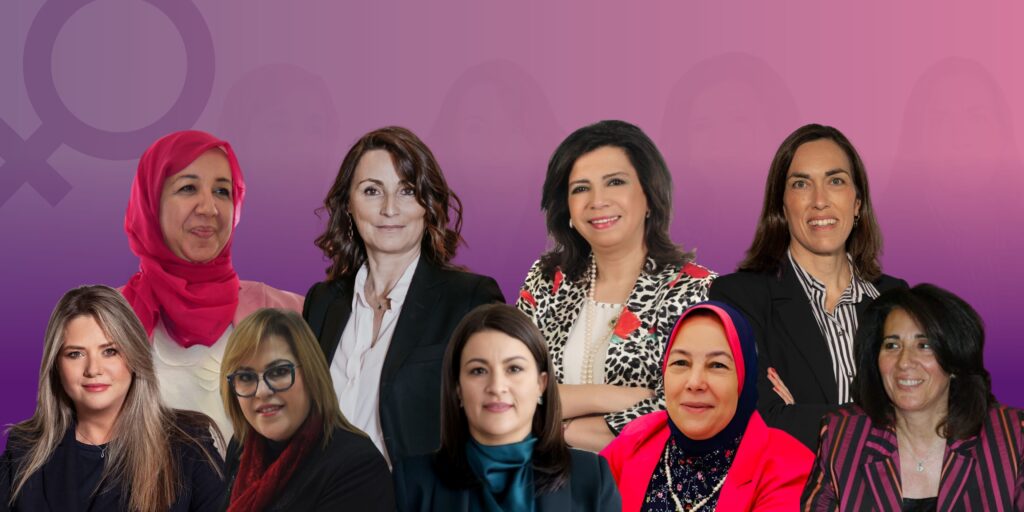
Gender inequalities affecting Mediterranean women in the business sphere have deep and persistent roots. They stem from a combination of cultural norms, insufficient support for women led enterprises, the underrepresentation of women in senior executive roles, the absence of robust policy frameworks to address gender gaps, and the ongoing challenge of reconciling work and family responsibilities. According to Ms. Berta Pérez, International Director at the Barcelona Chamber of Commerce, “these frictions are most visible for women led SMEs when they try to scale, and for women in STEM fields, where persistent gender stereotypes remain a major barrier”.
The scale of the challenge is reflected in the numbers. As Ms. Sawsan Wazzan, Board Member and President of the Women’s Committee of the Chamber of Commerce, Industry, and Agriculture of Beirut & Mount Lebanon, notes, “women led businesses represent less than 5% in the region, compared to around 23%–26% globally”.
For Ms. Catherine Gineste, elected member of the Aix Marseille Provence Chamber of Commerce and Industry (CCIAMP), the issue must be understood as one of “structural inequalities that are sometimes amplified by cultural stereotypes and by heterogeneous economic or regulatory contexts, yet the female entrepreneurial potential is immense.” She adds: “Today, the real challenge is no longer just equal access. It is equal impact, removing the direct barriers that limit the economic performance of our regions.” In her view, “visibility is key, and this can be achieved by integrating more women into representative bodies, promoting role models, and organising inspiring events”.
Gender inequalities affecting Mediterranean women in the business sphere have deep and persistent roots. They stem from a combination of cultural norms, insufficient support for women led enterprises, the underrepresentation of women in senior executive roles, the absence of robust policy frameworks to address gender gaps, and the ongoing challenge of reconciling work and family responsibilities
The pivotal role of the Chambers of Commerce
Chambers of Commerce play a crucial role in strengthening both women’s position within enterprises and the broader landscape of female entrepreneurship. As trusted intermediaries between the private sector, public authorities, and civil society, they are uniquely positioned to influence business cultures, shape policy agendas, and open pathways for women to participate fully in economic life. Through dedicated committees, training programmes, mentorship networks, and cross border cooperation initiatives, Chambers help women acquire the skills, visibility, and resources needed to thrive. They also advocate for regulatory reforms, encourage companies to adopt inclusive practices, and generate data that makes gender gaps more visible and actionable.
Ms. Gineste identifies four key levels of action that Chambers of Commerce must address to advance women’s economic participation: “Facilitating access to business networks and decision makers, where real opportunities emerge; providing training in female leadership; engaging in active advocacy with legislative authorities; and establishing concrete support mechanisms for growth, financing, and governance.” She highlights, for example, the importance of partnerships with banks to develop targeted financing instruments, where Chambers can act as trusted intermediaries.
In the same line, Ms. Dalenda M’hamdi Mekki, Central Director at the Chamber of Commerce and Industry of Tunis, emphasises that “Chambers have the power to transform women’s talent into a true engine of inclusive, resilient, and competitive growth across the Mediterranean and Africa”. She highlights the progress made in Tunis, “where the creation of a reliable database connected to the CPCCAF (Permanent Conference of African and Francophone Consular Chambers) network, regional competitions showcasing women’s excellence, and dedicated mentoring, coaching, and training programmes have strengthened the entrepreneurial ecosystem and expanded opportunities for women across the region”.
Ms. Georgia Linaraki, Deputy Chairwoman of the Department of Services at the Piraeus Chamber of Commerce and Industry (PCCI) and Vice President of VGROUP, also underscores the decisive role of Chambers in fostering female entrepreneurship: “Our institutions help women entrepreneurs exchange experiences, build confidence, and integrate more effectively into local and international value chains”. For Ms. Linaraki, the contribution of women entrepreneurs is fundamental: “Women are essential to shaping the future of the Mediterranean because they represent a powerful driver of inclusive and sustainable development. They contribute significantly to job creation, stimulate innovation, and often introduce business models that address social and environmental challenges”.
Chambers of Commerce play a vital role in strengthening women’s presence in companies and in the wider entrepreneurial ecosystem. As trusted intermediaries between business, public authorities, and civil society, they can shape business culture, influence policy agendas, and expand opportunities for women’s full economic participation
Chamber’s flagship initiatives for inclusion
There are lots of successful inclusive initiatives launched by the Mediterranean Chambers of Commerce which represent an effective and replicable model for other Chambers. One of this is the PCCI’s Women Entrepreneurship Support Office, which connects established business leaders with emerging women entrepreneurs through structured mentoring, training workshops, and international matchmaking events. In addition, this Chamber, as many others in the region, has since many years included women in its board of directors and its steering committee. “Our ladies members have their own committee in the board to follow, support, share necessary information and create networking platforms with stakeholders in various fields, such as social, financing, EU programs enhancing women’s entrepreneurship)”, explains Ms. Mary-Ann Vellis, PCCI’s General Secretary.
Another flagship example is the Barcelona Chamber of Commerce and Industry’s Observatory of Women, Business and Economy (ODEE), which combines rigorous research with concrete action. Specifically, the ODEE produces regular studies and reports on gender gaps in employment, entrepreneurship, leadership, STEM participation, and salaries, providing solid evidence to inform policy and business decisions.
To Ms. Berta Pérez, “this work is guided and reinforced by a multidisciplinary advisory council of women leaders from business, the academia, and institutions, which ensures strategic vision, relevance, and impact”. In her opinion, “the ODEE translates knowledge into mentoring, training, and tailored business support for women entrepreneurs and professionals”.
In addition, the CCI Tunis plays a leading role in promoting women’s entrepreneurship across Africa and the francophone world through different forums, workshops, and the CPCCAF Women’s Entrepreneurship Trophies. In 2025, this Chamber organized a major forum in Tunis for Women’s Entrepreneurship Day, highlighting innovation and sustainability and strengthening Euro-Mediterranean and African collaboration. Ms. Mekki underlines that “this event conclude with two cooperation agreements that reinforced national support for women-led businesses and opened new avenues for regional and international partnerships”.
Another great initiative is the Women Digital Job Center and the associated Women’s Entrepreneurship & Investment Programme (WEIP), implemented by the Chamber of Commerce, Industry and Agriculture of Beirut and Mount Lebanon. To Ms. Sawsan Wazan, the success of this initiative lies in five main reasons: “It provides practical tools -training, funding access, and mentorship- rather than focusing only on advocacy; it supports underprivileged women, fresh graduates, and women re-entering the workforce; it prepares women for digital jobs; it connects women entrepreneurs directly with investors and business networks, helping break the glass ceiling; and it promotes equal pay and inclusive hiring within Chambers while encouraging the broader business community to adopt similar practices”.
In the same line, the CCI Aix-Marseille-Provence created in 2021 the OSE! Forum, a program dedicated to female entrepreneurship. “When we launched the first edition, 70 women were present. Five years later, the 10th edition brought 1,000 participants, which reflects a real need”, explains Ms. Catherine Gineste. To her, the strengths of the platforms lie in three key pillars: “Qualified networking between female leaders, economic partners, and financiers; the provision of concrete tools on financing, strategy, and growth structuring; and the promotion of inspiring journeys, to make successful trajectories visible”.
There are two more insightful initiatives. The first is The House of the Green Economy, launched in the province of Ouezzane (Morocco) by the Chamber of Commerce, Industry and Services of Tangier-Tétouan-Al Hoceima (CCISTTA). According to Ms. Soad Sebbah, Head of Partnership Service in Economic Diplomacy In charge of presidential affairs of the CCISTTA, “the project aims to develop female entrepreneurship, support local businesses and cooperatives, create more jobs and companies, and strengthen the economic empowerment of women while facilitating the access to national and international markets”.
The second one is the MAMi Project -Mediterranean and Africa Markets Initiative-, launched by the Alexandria Chamber of Commerce. “Building on a vision that farmers markets can be engines of social cohesion and sustainable growth, the Chamber worked to introduce in Alexandria a farmers market model that links rural producers with urban consumers while creating concrete opportunities for women and young entrepreneurs”, explains Ms. Eman Seif, Deputy Secretary General at the Alexandria Chamber of Commerce.
Gender gaps between the Northern and Southern Mediterranean
Are there differences between the North and South of the Mediterranean talking about women’s inclusion at all levels? We asked this question to women representing different institutions in the Mediterranean, and the answer was unanimous. In the North, legal frameworks tend to be stronger and economic ecosystems more structured. Yet, despite these advantages, cultural glass ceilings persist, limiting women’s full participation and advancement. In the South, women often face barriers rooted in social norms, economic constraints, and unequal family responsibilities, all of which hinder their ability to engage fully in economic and business life. At the same time, as Ms. Berta Pérez highlights, “there is strong potential, with a young and educated female talent pool and fast growing entrepreneurship ecosystems, including in STEM and digital sectors”.
Mediterranean Chambers of Commerce are driving inclusion through high‑impact, replicable initiatives. They have launched women‑focused support offices, research‑to-action observatories, and digital job and entrepreneurship programs that provide mentoring, training, funding access, and direct links to investors. They also lead regional forums and awards that strengthen cross‑Mediterranean cooperation and visibility for women-led businesses
In this regard, Ms. Soad Sebbah notes that “the differences observed between both shores of the Mediterranean should not be interpreted as gaps in ability or ambition, but rather as the expression of distinct contexts, priorities, and rates of development”. In addition, Ms. Ioanna Boukis, Member of the PCCI’s Administrative Council and Business Developer at Boukis Amorteam, underlines that “a common denominator across both regions is the unequal distribution of caregiving responsibilities and the limited representation of women in strategic decision-making positions”.
To Ms. Catherine Gineste, “Mediterranean cooperation can reduce these gaps”. She talks about “sharing best practices, joint mentoring, and regional projects”. To her, “the exchange of experiences is an accelerator of inclusion”. In the same line, Ms. Pérez assures that “the Mediterranean diversity is a strength, and progress will accelerate through cooperation at all levels, including both North-South and South-South partnerships”.