
Events Ascame/ February 13, 2026/ Ascame members, Featured
At the recent EU leaders’ summit, held on 12 February 2026 at the Alben Biesen Castle (Belgium), Europe faced a crucial question: is it truly committed to its sovereignty, security, and long-term prosperity? The vision of “Made in Europe” must guide all policy decisions aimed at strengthening the competitiveness of European manufacturing. Europe’s 26.1 million industrial and craft enterprises provide 65% of employment and offer unique know how and training opportunities, making them vital for innovation, resilient supply chains, and vibrant communities across both rural and urban areas. To enhance SMEs’ competitiveness, preparedness, and resilience, appropriate tools and support mechanisms are essential. These must ensure business continuity and help companies navigate an increasingly complex and demanding global environment.
European manufacturing and processing SMEs drive local prosperity and sustain Europe’s global competitiveness. However, many still struggle with complex regulations, fragmented markets, high energy costs, unfair competition, and limited access to finance. Regulatory simplification and relief from unnecessary administrative burdens are essential to prevent new obstacles from emerging. At the same time, legal certainty and a level playing field must be ensured. Legislation should be designed with SMEs in mind from the outset, with proportionate requirements, realistic timelines, clear guidance, and protective measures that safeguard European production. Member States must also avoid overimplementation and ensure consistent application and enforcement of EU rules, including in their relations with third-country trade and investment partners.
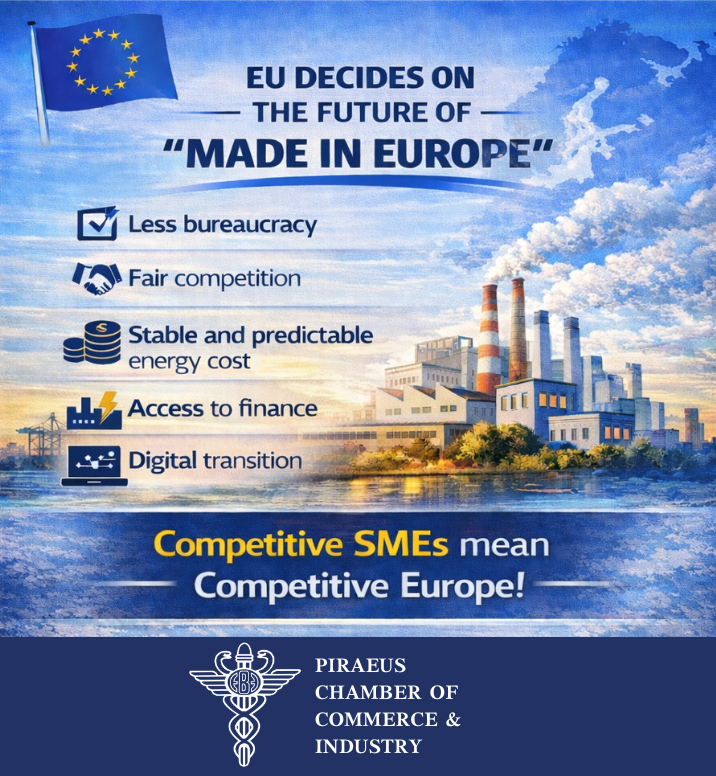
The Piraeus Chamber of Commerce and Industry supports the position of the Hellenic Federation of Enterprises (SEV) and endorses the five key proposals put forward by Europe’s employers’ organisations. First, authorities must trust entrepreneurs to deliver policy objectives without prescribing every step through excessive bureaucracy, allowing them the freedom to operate and grow both locally and across borders within an enabling regulatory framework.
Second, the EU must fully leverage the Single Market as a driver of competitiveness. Ensuring fair competition is essential: openness should not undermine the viability of European companies but must guarantee a level playing field between EU and non-EU businesses, particularly in the digital economy. Third, energy resilience remains fundamental. SMEs cannot be expected to invest and expand while facing volatile and unpredictable energy costs. Fourth, improved access to finance and skilled talent continues to be a decisive factor for SME competitiveness. Fifth, Europe must achieve digital sovereignty in a way that works for SMEs, ensuring secure access to data, infrastructure, and digital tools without imposing disproportionate administrative burdens.
The future of European entrepreneurship will be determined by the crucial decisions of European leaders and, in these decisions, manufacturing SMEs must be recognized as a strategic priority. How many and who share the “buy European” initiative, giving impetus to Europe’s industry, and who has reservations about “Made in Europe” remains to be seen. What is certain, is that two “camps” have formed in the EU, with the German-Italian camp not wanting protectionist measures that could alienate third-country trading partners and foreign investment interests. I believe that Greece will side with the countries that want a Europe with high public investment, with reduced dependence, differentiated rules, less bureaucracy, and stronger support for domestic industry and crafts. Competitive small and medium-sized enterprises also mean a competitive Europe.
This opinion article has been written by Mr. Vassilis Korkidis, President of ASCAME’s member, the Piraeus Chamber of Commerce and Industry.