
Events Ascame/ July 29, 2026/ Featured, Trends
Six months of conflict in the Persian Gulf have transformed what initially appeared to be a regional military confrontation into a defining global economic challenge. The prolonged instability has fundamentally altered the dynamics of international trade, maritime transport, energy markets and investment decisions. Today, geopolitical risk is no longer an external variable; it has become a core economic indicator that governments and businesses must incorporate into every strategic decision.
For Greece, a country whose prosperity is closely linked to shipping, trade, tourism and international logistics, the consequences are particularly significant. Our economy may be geographically distant from the battlefield. Still, it is deeply connected to the maritime routes, energy supplies and global supply chains that pass through one of the world’s most critical strategic corridors.
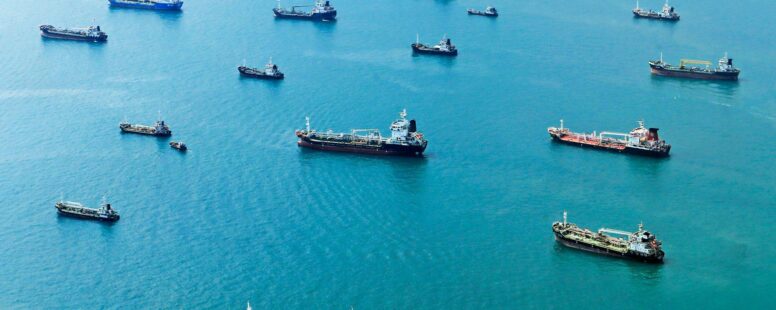
The Strait of Hormuz remains the most important maritime energy gateway on the planet. Roughly one-fifth of global oil consumption and a substantial share of liquefied natural gas exports pass through this narrow passage. After six months of conflict, uncertainty has become the new normal. Even when cargoes continue to move, the cost of moving them has increased considerably. War-risk insurance premiums, freight rates, fuel consumption and operational expenses have all risen, while shipping companies are forced to redesign routes and operational plans under unprecedented security conditions.
History has repeatedly shown that prolonged geopolitical crises do not only affect energy prices; they reshape international commerce itself. The impact gradually spreads from oil markets to industrial production, manufacturing costs, transportation, food prices, and ultimately household budgets. Inflationary pressures re-emerge not because demand is excessive, but because supply becomes more expensive and less predictable.
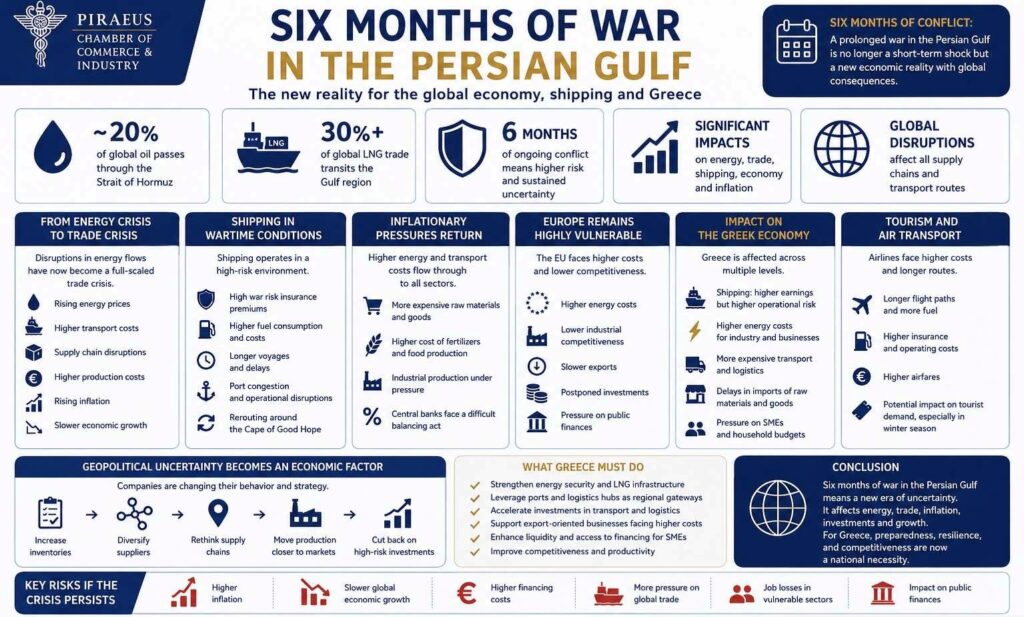
European businesses are once again facing higher production costs and declining competitiveness. Although Europe has made substantial progress in diversifying its energy sources since the energy crisis of recent years, it remains heavily dependent on global maritime trade. Any disruption affecting strategic sea lanes immediately influences industrial production, exports and investment decisions across the continent.
For Greece, the picture is more complex. Our shipping industry, which controls one of the world’s largest merchant fleets, has demonstrated remarkable resilience throughout previous international crises. Higher freight rates may temporarily strengthen revenues in certain shipping segments, but these opportunities are accompanied by substantially greater operational risks, security concerns, and financial exposure. Furthermore, coastal shipping and passenger-car ferry companies are suffering from the high cost of marine fuel. At the same time, the domestic economy experiences the opposite effect. Businesses face rising energy costs, more expensive imported raw materials, longer delivery times, and renewed inflationary pressures. SMEs find themselves under increasing pressure as they struggle to absorb higher operating costs while maintaining competitive prices for consumers.
History has repeatedly shown that prolonged geopolitical crises do not only affect energy prices; they reshape international commerce itself. The impact gradually spreads from oil markets to industrial production, manufacturing costs, transportation, food prices, and ultimately household budgets
This is precisely where economic resilience becomes more important than economic growth alone. The lesson from the past six months is clear: resilience has become a competitive advantage. Companies are diversifying suppliers, increasing inventories, relocating production closer to consumer markets, investing in digital logistics, and reassessing supply chain risks. Governments are accelerating investments in strategic infrastructure, energy security, ports, and logistics hubs.
Greece has a unique opportunity to strengthen its strategic position. Our ports, our maritime expertise, our logistics infrastructure, and our role as an energy gateway in Southeastern Europe provide significant comparative advantages. Investments in LNG infrastructure, intermodal transport, port modernization, and digital logistics can transform today’s geopolitical uncertainty into tomorrow’s economic opportunity.
However, this transition requires decisive policy choices. Supporting export-oriented businesses, improving access to finance for SMEs, reducing administrative burdens, accelerating infrastructure investments, and strengthening supply-chain resilience should become national priorities. Competitiveness cannot be maintained through temporary support measures alone; it requires structural reforms that increase productivity and reduce the cost of doing business. The business community understands that geopolitical crises cannot be controlled. What can be controlled is our preparedness.
Economic policy must therefore focus not only on managing today’s challenges but also on preparing Europe for tomorrow’s global economy where geopolitical disruptions are likely to become more frequent rather than exceptional. The world is entering an era in which security, resilience, sustainability, and competitiveness are inseparable.
Six months of war in the Persian Gulf remind us that economic stability can no longer be taken for granted. The countries and businesses that will emerge stronger are those that invest today in resilience, adaptability, and strategic foresight.
As representatives of the business community, we believe that EU possesses the experience, the entrepreneurial spirit, and the strategic assets necessary, not only to withstand this new environment, but to strengthen its position within it. The future belongs to economies that are prepared, not simply for growth, but for uncertainty.
Opinion article written by Mr. Vassilis Korkidis, President of the Piraeus Chamber of Commerce and Industry and Vice President of ASCAME.