
Events Ascame/ July 15, 2026/ Featured
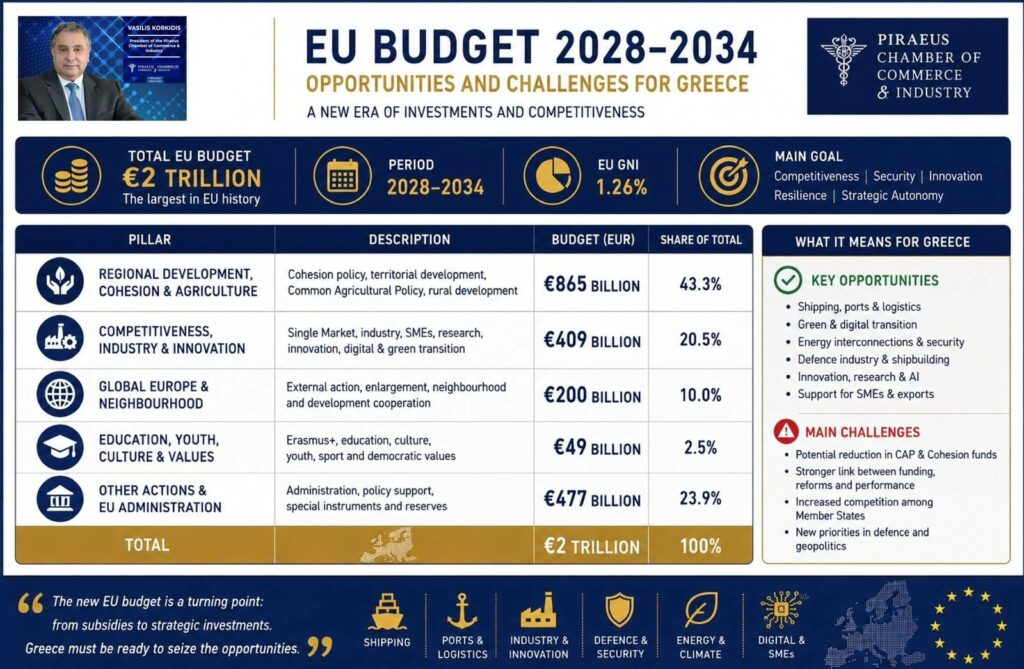
The European Commission’s proposal for the 2028–2034 Multiannual Financial Framework (MFF) marks one of the most ambitious financial plans in the history of the European Union. With a budget approaching €2 trillion, the new framework goes far beyond a traditional seven-year cycle. It represents Europe’s strategic response to a rapidly evolving global environment defined by geopolitical instability, technological competition, climate pressures, energy security concerns, and the need to reinforce industrial resilience.
Unlike previous MFFs, which focused primarily on cohesion and agricultural support, the next EU budget introduces a decisive shift toward competitiveness, innovation, defense, strategic autonomy, and industrial policy. While the Common Agricultural Policy (CAP) and Cohesion Policy remain essential pillars, the emphasis now lies on strengthening Europe’s productive capacity and securing its global economic position.
For Greece, this transformation presents both a major opportunity and a significant challenge. The proposed budget signals a transition from a redistribution-oriented model to an investment-driven approach. Europe aims to finance projects that generate long-term economic value, enhance productivity, promote technological leadership, and reduce strategic dependencies on external suppliers.
Substantial resources will support research and innovation, Artificial Intelligence, digital transformation, clean energy, critical infrastructure, defense capabilities, and industrial competitiveness. These priorities are designed to reinforce Europe’s economic resilience while advancing the green and digital transitions, areas where Greece is well positioned to benefit.
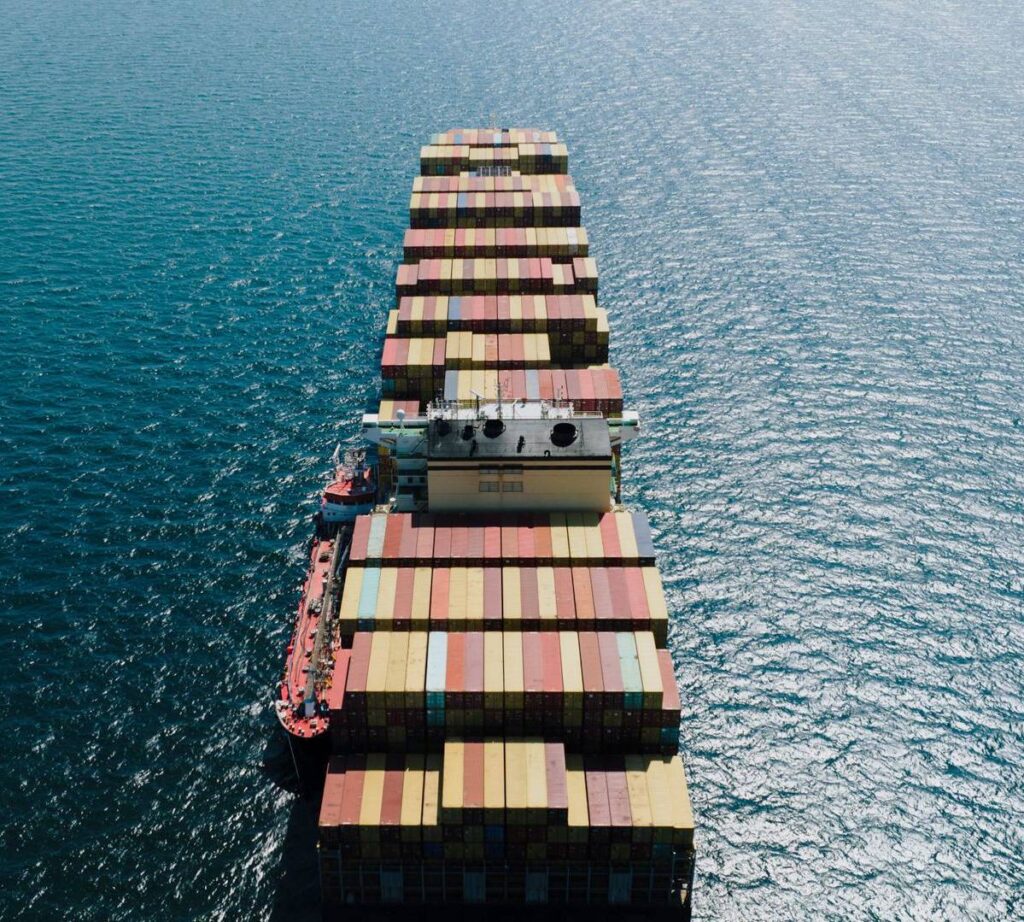
As one of Europe’s leading maritime nations, Greece can leverage increased funding for sustainable shipping, alternative marine fuels, digital maritime technologies, and zero-emission transport. The country’s globally dominant merchant fleet, together with its expanding shipbuilding and ship repair sector, can play a central role in achieving the EU’s climate and industrial objectives.
The Port of Piraeus, one of the Mediterranean’s largest logistics hubs, is also expected to benefit from investments in transport infrastructure, supply chain resilience, port digitalisation, and intermodal connectivity. These developments could further strengthen Greece’s role as a strategic gateway between Europe, Asia, and Africa.
As one of Europe’s leading maritime nations, Greece can leverage increased funding for sustainable shipping, alternative marine fuels, digital maritime technologies, and zero-emission transport
Equally important are the opportunities for Greece’s industrial sector. The EU’s growing focus on defense, strategic manufacturing, and critical technologies opens new prospects for Greek manufacturing companies, shipyards, engineering firms, and technology providers. Investments in energy infrastructure – LNG terminals, electricity interconnections, renewable energy projects, and hydrogen networks – are also expected to remain among the Union’s highest priorities.
Small and medium sized enterprises (SMEs), the backbone of the Greek economy, stand to benefit from expanded programmes supporting digitalisation, cybersecurity, artificial intelligence, innovation, export capacity, and access to finance. Yet despite these opportunities, Greece will face important challenges in the new programming period.
First, the relative share of funding allocated to traditional cohesion and agricultural policies may gradually decline as new priorities demand larger financial resources, increasing competition for EU funding.
Second, access to resources will increasingly depend on measurable performance, structural reforms, and effective project implementation. The experience of the Recovery and Resilience Facility has shown that the EU now prioritises accountability, efficiency, and results over simple fund allocation.
Third, Member States will compete more aggressively to attract strategic investments in advanced manufacturing, defense, artificial intelligence, energy, and digital infrastructure. Success will depend not only on available funding but also on each country’s ability to prepare mature, investment-ready projects.
To maximise the benefits of the new EU budget, Greece should focus on five strategic priorities:
- Strengthening maritime transport, shipbuilding, and the blue economy.
- Modernising ports and logistics infrastructure.
- Accelerating the digital transformation of SMEs.
- Expanding energy interconnections and renewable energy investments.
- Enhancing industrial competitiveness, exports, and technological innovation.
These priorities align closely with the EU’s long-term objectives and can significantly improve Greece’s economic resilience and international competitiveness. The EU Budget 2028–2034 is more than a financial framework: it is a strategic roadmap for Europe’s future. It signals a decisive shift toward investment, competitiveness, innovation, and strategic autonomy.
The EU Budget 2028–2034 is more than a financial framework: it is a strategic roadmap for Europe’s future. It signals a decisive shift toward investment, competitiveness, innovation, and strategic autonomy
For Greece, success will depend on moving beyond the traditional model of fund absorption and embracing a new approach focused on high-value investments, accelerated reforms, and strengthened productive capacity. As Europe enters a new era of strategic investment, Greece has a unique opportunity to leverage its maritime leadership, geographic position, industrial potential, and entrepreneurial ecosystem to become a stronger pillar of the European economy.
In this framework, Mr. Vassilis Korkidis, President of the Piraeus Chamber of Commerce and Industry and Vice President of ASCAME, shares the following reflection: “The new EU Budget 2028–2034 marks a historic transition from subsidies to strategic investment. Greece must capitalize on its maritime leadership, logistics infrastructure, industrial capabilities and innovative SMEs to secure a larger share of European funding and transform these resources into sustainable growth, higher competitiveness, quality employment, and long-term economic resilience”.
Opinion paper by Mr. Vassilis Korkidis, President of the Piraeus Chamber of Commerce and Industry and Vice President of ASCAME.