
- President, ASCAME Industrial Cooperation & Outsourcing Commission
- President, Algerian-Spanish Trade and Industry Circle
Between Algeria and Spain, economic relations have always been good. The historical exchanges recorded go back to the first millennium, the exchange being natural by the geographical proximity – with both sides of the Mediterranean – and by their respective and successive incursions.
Today the two countries have consolidated their relationship by a sustainable energy connection through the two pipelines, the Pedro Duran Farell, (PDF), and Medgas. The idea was and still is to deliver Algerian gas via Spain to European customers. It is clear that this cooperation has the logical purpose of supporting trade on both sides and consolidating other sectors of activity.
It should be recalled that both economies have undergone major changes. Spain has suffered a serious economic crisis that has cost seven difficult years of sacrifice from 2008 to 2015 to finally return to growth, recording the best European performance in 2016 and 2017. Algeria was not spared: from 2014 until today the balance of transactions remains negative generating a budget deficit and a public debt crescendo by consequence.
By analyzing Table I (below), related to the trade recorded on the Algerian trade balance, comparing Spain with the rest of the world, it should be noted that it is constant in quantitative volumes. There are fewer Algerian import transactions since 2015 due to the financial imbalance suffered after falling oil prices. This trend will continue until 2020 according to the forecasts. Consumer goods were banned from imports in 2017 and 2018. The trade balance has been in a clear deficit since 2015. However, the deficit trend is currently down, due to the rise in hydrocarbon prices at the end of the year 2017 and early 2018. Concerning the Spanish imports from Algeria the trend is linear in quantitative volume and in value volume the figures have been divided almost by three between 2014 and 2016 and then registered an increase in 2017.
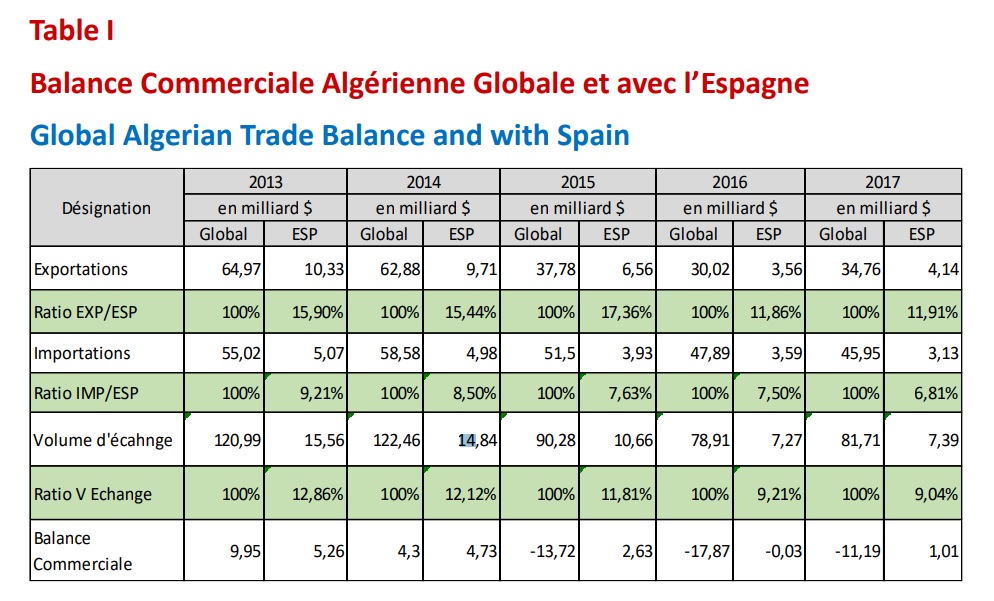
Apart from these years of financial imbalance due to the sharp drop in hydrocarbon prices in 2014, 2015 and 2016, the trade situation remains generally regular.
On the other hand, there have been interesting exchanges in terms of services. Spanish companies have participated in construction and infrastructure: railways, ports, airports, trams, desalination plants, power plants, and other major achievements throughout the period of the three major five-year Algerian plans (2000 – 2015). Algerian imports have never stopped, mainly intermediate materials and building materials.
Spain and Algeria made their first gas connection in 1999, with the PDF pipeline and their second in 2011, Medgas.
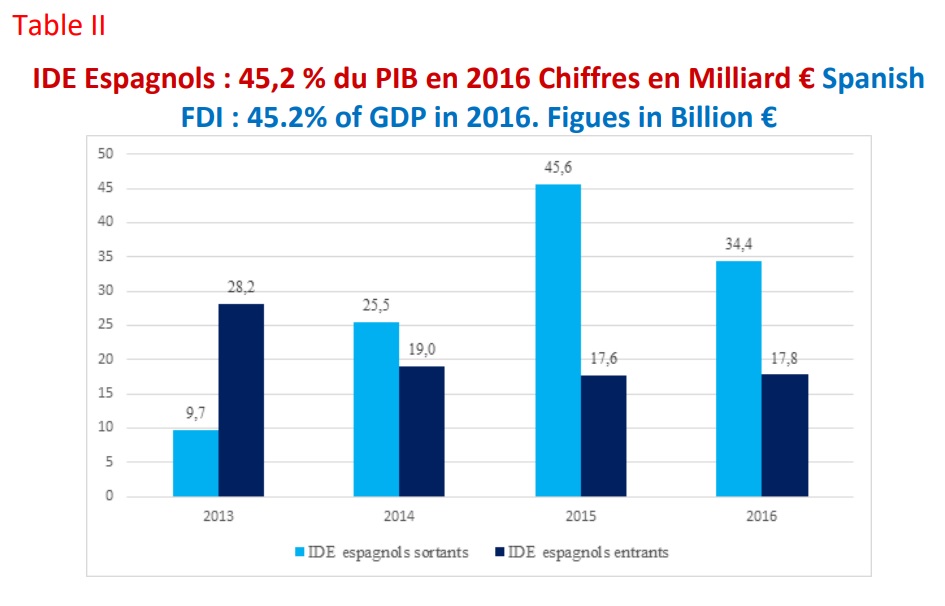
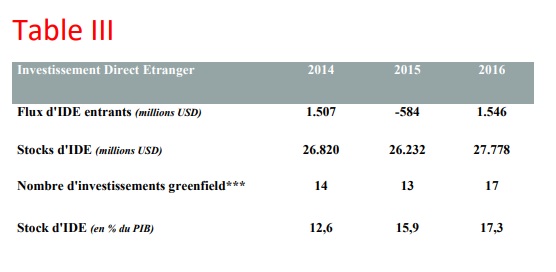
In terms of investment, trade is weak if we take into account the performance of Spain and the Algerian potential. Table III clearly indicates that Algeria is not traditionally an attractive country for Foreign Direct Investment (FDI) and Table II provides information on FDI flows from Spain both inward and outward. Spanish companies have invested heavily abroad. This internationalization comes as a result of new inflexions of an economic policy born of the 2008-2015 crisis. In 2017 Spain is attracting more FDI and has recorded 140% more than in 2016, placing it sixth in the world in terms of FDI stock.
Outward FDI amounts to more than $ 34 billion in 2016, mainly in Europe, South America and the United States of America. Some companies that are proactive towards the Algerian and Maghreb market have decided to carry out Greenfield investment projects and have done very well despite the administrative delays, such as Fertial (mixed investment Fertiberia-Asmidal), Gallina Blanca (GB Foods), Dulcesol and other SMEs in various sectors. In Spain, two Algerian companies have invested and are essentially public: Sonatrach and Algeria Telecom. These investment operations on both sides are far from constituting an investment-device imposing large means and a medium and long-term vision.
What needs to be improved to intensify this productive exchange between the two countries?
To invite foreign companies to come and invest in Algeria, the Algerian public authorities should significantly improve the “location advantage”, ie the implementation of policies promoting FDI and thus make Algeria an attractive host country. In addition, we observed significant fluctuations in the country ranking of the business climate. Although some reforms are well and truly accomplished, they are not communicated or well communicated to these ranking bodies, such as “doing business” of the World Bank and the FMI.
In general, two provisions of the Algerian investment code are decried by foreign investors:
1- Restricted mobility of capital, be it in terms of repatriation of profits or replacement of own capital in other subsidiaries abroad. Indeed, the mobility of capital is not flexible because of a strict control operated by the bank of Algeria. The monetary system is controlled by the fact that Algeria relies only on hydrocarbon exports and imports a large and wide range of equipment and consumer goods. It is obvious that for the promotion of FDI this measure should be reviewed and adapted to the needs of foreign companies;
2- Rule 51 – 49, entitling the foreign company to own only 49% of the share capital. At this level, opinions are mixed. It is clear that for service companies, the rule does not constitute a major obstacle. On the other hand, for manufacturing companies, it is difficult to retain 49% of the shares of technology and know-how, despite the possibility of controlling management. It is the very principle of the property which is questioned in particular in capital intensive productions, according to many manufacturers that I met.
Based on this observation, only a clear policy of FDI promotion could strengthen the position of the territory of Algeria with multinational firms and foreign companies encouraging them to invest in the country. To do this in my opinion, an observatory should be created to monitor the evolution of the promotion of FDI, consisting of a broad spectrum of representatives of direct and indirect stakeholders in improving the business climate of the Algerian destination. Also, the Algerian state should facilitate the steps towards the national companies to internationalize. These same companies operating internationally would be best able to drain the FDI in Algeria because many are unknown and not highlighted advantages. The proof is that few foreign companies divest in Algeria.
On the other hand, from the Spanish side, it seems to me that companies should develop more awareness of the potential market that is emerging both domestically and regionally (sub-Saharan). Algeria will have 50 million inhabitants by 2025 and the public authorities continue to invest in the infrastructure that brings it closer to the Sahel countries: the road branches, the trans-Saharan, the great port of Cherchell and the new airports…
Not to forget the new discoveries of gas and mining deposits throughout the territories of the country’s south.
In conclusion, I think that in view of the regional developments and the needs of the African continent for its development and growth, countries like Spain and Algeria with their geographical positions and their economic connection should find all the intelligence to address sub-Saharan Africa, this using all the Factors of Production.
05/07/2018