
Oscar Maronda/ October 13, 2026/ Featured, Trends
Energy costs shape Europe’s ability to create businesses, sustain production and attract investment. For entrepreneurs, expensive and unpredictable electricity, gas and transport fuels squeeze margins and make expansion harder to plan. The challenge concerns both affordability and predictability: a business needs to know whether it can remain competitive throughout an investment’s lifetime.
The European Investment Bank’s 2025 Investment Survey found that 75% of EU firms considered energy costs an obstacle to investment. This illustrates how energy affects decisions across the economy, beyond the most energy-intensive industries. Prices have also shown periods of improvement. Eurostat reported an average EU non-household electricity price of €0.1837/kWh in the second half of 2025, down 3.5% from the previous half-year. This measure covers businesses consuming 500–2,000 MWh annually; it does not represent every SME’s tariff or current October 2026 prices.
SMEs face a particularly difficult adjustment. Small businesses often have less bargaining power with suppliers, fewer resources to manage price risks and limited access to finance for efficiency upgrades. EIB research identifies financing and implementation barriers to energy-efficiency investment among smaller firms.
An illustrative calculation shows how sensitive profits are. A company with €1 million in annual revenue, €50,000 in operating profit and €40,000 in energy expenditure would lose €10,000 if its energy bill rose by 25%, assuming everything else remained unchanged. Operating profit would fall by 20%, even though the additional expense represented only 1% of turnover.
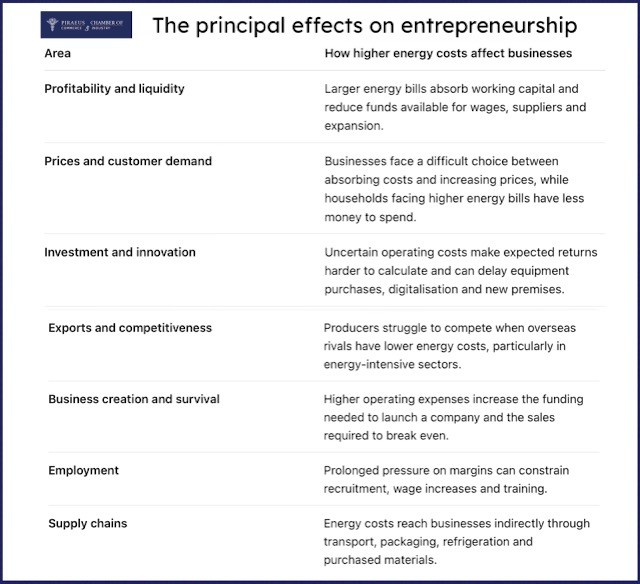
There are also entrepreneurial opportunities. Demand for energy efficiency, renewable generation, storage, building renovation, and energy-management services can create new markets. However, capturing these opportunities depends on access to capital and the practical capacity to implement projects. A firm struggling to pay its monthly bills may be unable to finance an upgrade that would reduce future costs.
The EU policy priority should therefore be to combine immediate resilience with lasting reductions in energy expenditure:
- Make efficiency investment accessible to SMEs, through simple grants, guarantees and affordable loans.
- Expand access to predictable electricity contracts, including pooled purchasing and long-term renewable power agreements.
- Improve grids, interconnections and storage, so businesses can benefit more consistently from low-cost generation.
- Review taxes and levies on business energy bills, while recognising the fiscal cost of relief.
- Provide targeted, temporary support during exceptional shocks, with clear eligibility and an exit path.
- Use Chambers of Commerce to support smaller firms through energy advice, joint procurement and assistance with funding applications.
Affordable and predictable energy is a foundation of European entrepreneurship. The practical test of energy policy is whether a business can invest, hire and grow while covering its operating costs, and whether smaller firms can participate in that progress.
Article written by Mr. Vassilis Korkidis, President of the Piraeus Chamber of Commerce and Industry and Vice-President of ASCAME.