
Oscar Maronda/ October 15, 2026/ Ascame projects, Featured
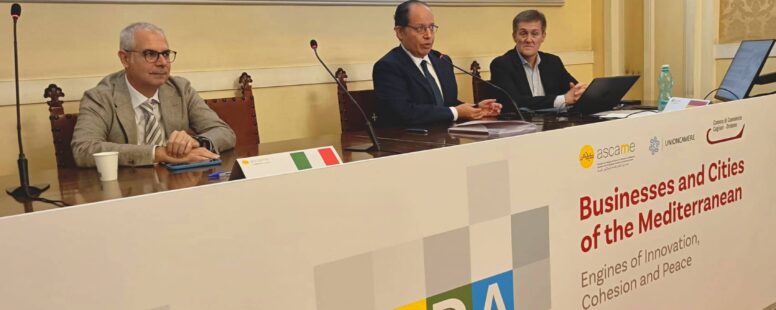
MedaCity Forum 2026 kicked off with the workshop “The Main Euro-Mediterranean Cooperation Programmes: Interreg NEXT MED and PRIMA – Current Programming Period and Future Challenges”. The session brought together representatives from the managing bodies of both programmes, with ASCAME playing an active role as a key partner. Participants reviewed the achievements and outcomes of the current programming period while exploring the priorities and opportunities that will shape the 2028-2034 cycle. The workshop fostered dialogue on the future of Euro-Mediterranean cooperation. It highlighted the strategic role of these programmes in addressing shared regional challenges and promoting sustainable development across the Mediterranean.
Opening the session, Mr. Emanuele Cabras, EuroMed Cooperation Advisor at the Chamber of Commerce of Cagliari-Oristano and President of OpenMed, highlighted the long-standing role of Chambers of Commerce in strengthening Euro-Mediterranean cooperation and facilitating access to European programmes for the private sector. He recalled the experience developed during the ENPI CBC MED 2007-2013 programming period, when the Chamber of Commerce of Cagliari, in cooperation with ASCAME, established a dedicated support mechanism to inform Mediterranean Chambers about European funding opportunities, facilitate access to cooperation programmes, support project development, and foster strategic partnerships. The initiative also aimed to strengthen the participation of private sector organisations in regional cooperation efforts.
The results demonstrated the growing engagement of Chambers in Euro-Mediterranean projects, with 21 projects involving Chambers of Commerce, 44 participations as project partners, and €14.6 million managed by Chamber institutions, representing around 7% of the programme’s overall budget.
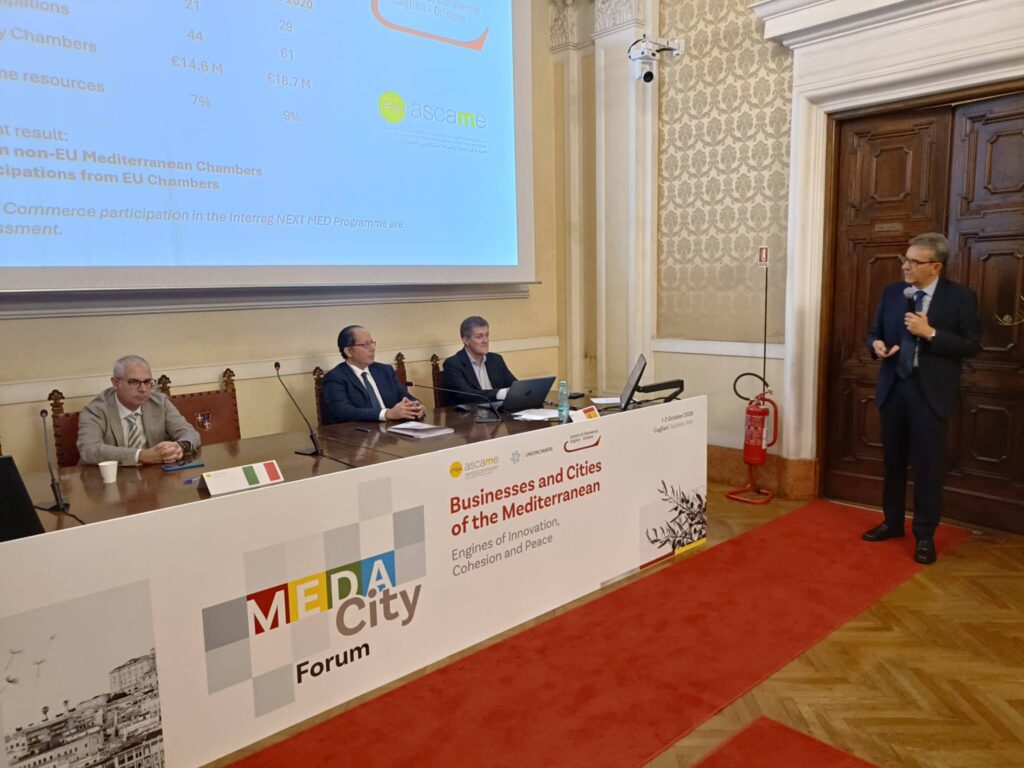
Mr. Cabras also stressed the importance of building on this experience to support the implementation of the new Pact for the Mediterranean. In this context, he highlighted ASCAME’s active contribution to promoting a more inclusive and business-oriented Mediterranean partnership, with particular attention to SME development, skills and vocational training, women’s economic empowerment, youth employability, and the green and digital transformation of enterprises.
Mr. Emanuele Cabras (Chamber of Commerce of Cagliari-Oristano): Chambers of Commerce play a key role in facilitating access to cooperation programmes, supporting project development, raising awareness of European funding opportunities, and fostering strategic partnerships
INTERREG NEXT MED: Strengthening cooperation across the Mediterranean
During the workshop, Mr. Aldo Puleo, Programme Manager of Interreg NEXT MED, presented the latest developments of one of the European Union’s main cooperation programmes in the Mediterranean. His intervention highlighted how the programme is helping organizations, institutions, and local communities work together to address common challenges and create new opportunities across the region.
Today, Interreg NEXT MED connects 15 Mediterranean countries and more than 100 territories, bringing together partners from both shores of the Mediterranean. With over 200 million people living in the cooperation area, the programme has already supported 108 projects involving 715 organizations, backed by €231 million in EU funding. These projects focus on practical solutions that contribute to more sustainable, innovative, and inclusive development throughout the region.
Mr. Puleo also shared some of the programme’s recent achievements, particularly in sustainable tourism. One key success has been creating a common framework that allows different Mediterranean cooperation programmes to work more closely, share knowledge, and build on successful experiences. He also highlighted the Mediterranean Peer Learning Visits, which enable project partners from different countries to exchange ideas, learn from one another, and adapt effective solutions to their local contexts.
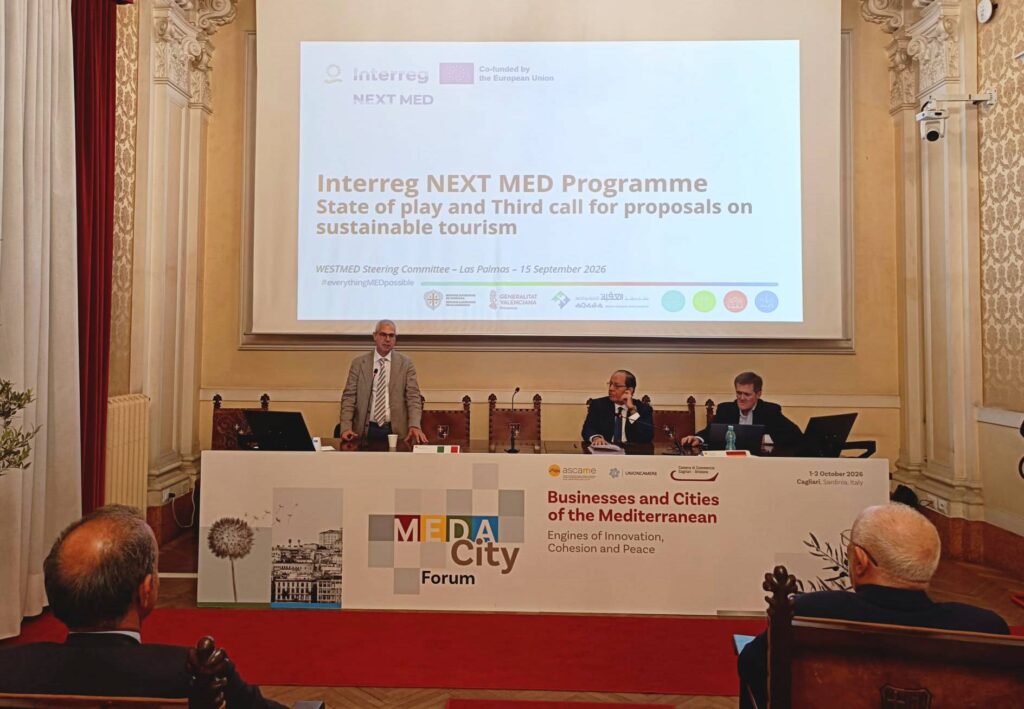
A key part of the presentation focused on the third call for proposals on sustainable tourism, launched in cooperation with nine other Interreg programmes under the Mediterranean Multiprogramme Mechanism. With a budget of €8 million, the call aims to support projects that can adapt and reuse solutions that have already delivered positive results elsewhere in the Mediterranean. By encouraging organizations to build on existing knowledge rather than starting from scratch, the initiative seeks to maximize impact and promote more sustainable tourism models across the region.
Looking ahead, Mr. Puleo also presented the first steps towards the post-2027 programming period, emphasizing that the future programme should respond to emerging challenges and evolving needs across the Mediterranean while building on the lessons learned from current projects. He stressed the importance of involving national authorities and stakeholders in shaping the next phase of cooperation and highlighted the strong support expressed for continuing and strengthening the programme beyond 2027, with a greater focus on scaling up successful initiatives and increasing their long-term impact.
Mr. Aldo Puleo (Interreg NEXT MED): As we look beyond 2027, our priority must be to build on the achievements of current programmes while adapting to the Mediterranean’s evolving challenges. The next phase of cooperation should be shaped by stakeholders across the region and focused on delivering greater scale, impact, and long-term value
PRIMA: Research and innovation for a more resilient Mediterranean
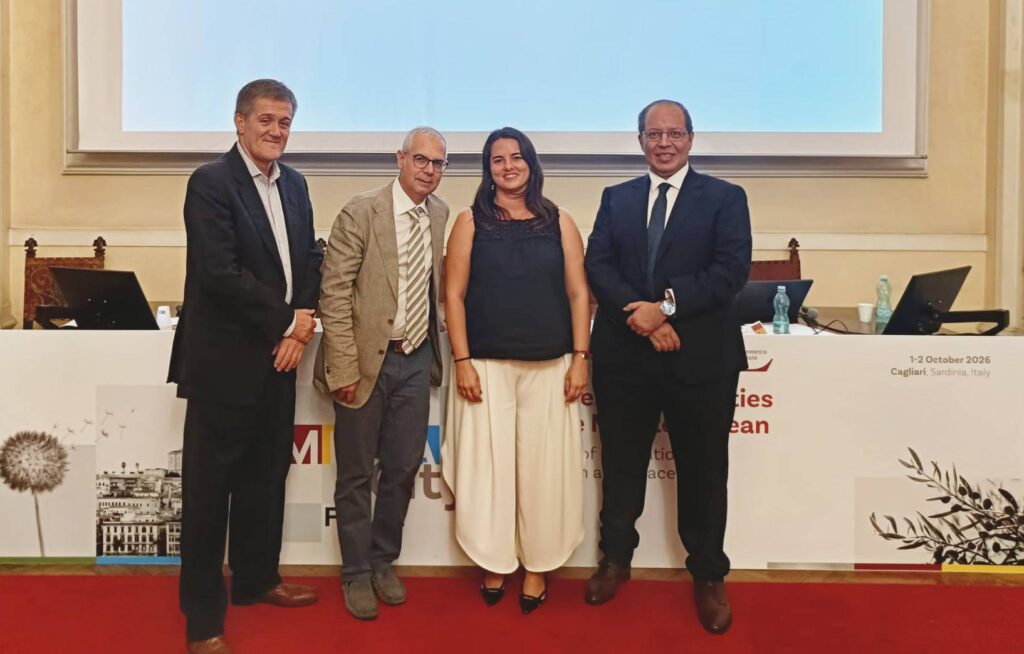
In addition, Dr. Mohamed Wageih, Project Officer at PRIMA, presented the role of the programme in addressing some of the region’s most pressing challenges through research, innovation, and cross-border cooperation.
Wageih highlighted that many of the Mediterranean’s key challenges, including climate change, water scarcity, food security, social inequalities, unemployment, and fragmented development, transcend national borders and therefore require joint solutions. In this context, PRIMA serves as a flagship Euro-Mediterranean initiative that brings together countries, institutions, researchers, and innovators to develop practical responses that contribute to a more sustainable, resilient, and prosperous Mediterranean region.
Since its launch in 2018, PRIMA has supported 305 projects with a total budget of €479 million, engaging more than 2,900 beneficiaries across the Mediterranean. Its activities focus on four main areas: sustainable water management, climate-resilient farming systems, sustainable agri-food value chains, and the Water-Energy-Food-Ecosystems (WEFE) Nexus. Through these projects, PRIMA seeks to generate innovative solutions capable of improving resource management, strengthening food systems, and enhancing environmental sustainability throughout the region.
A key message of the presentation was that successful research should ultimately translate into tangible benefits for society. According to Mr. Wageih, “success must be measured by impact, not simply by deliverables and outputs”. In his opinion, “a successful research project should not end with a publication, a prototype or a final report. Its real value comes when solutions are adopted, demonstrated, transferred, commercialised, replicated and scaled, reaching farmers, companies, policymakers and the Mediterranean communities”. In this regard, PRIMA promotes collaboration between researchers, policymakers, businesses, and local communities to ensure that innovation delivers measurable economic, social, and environmental impact.
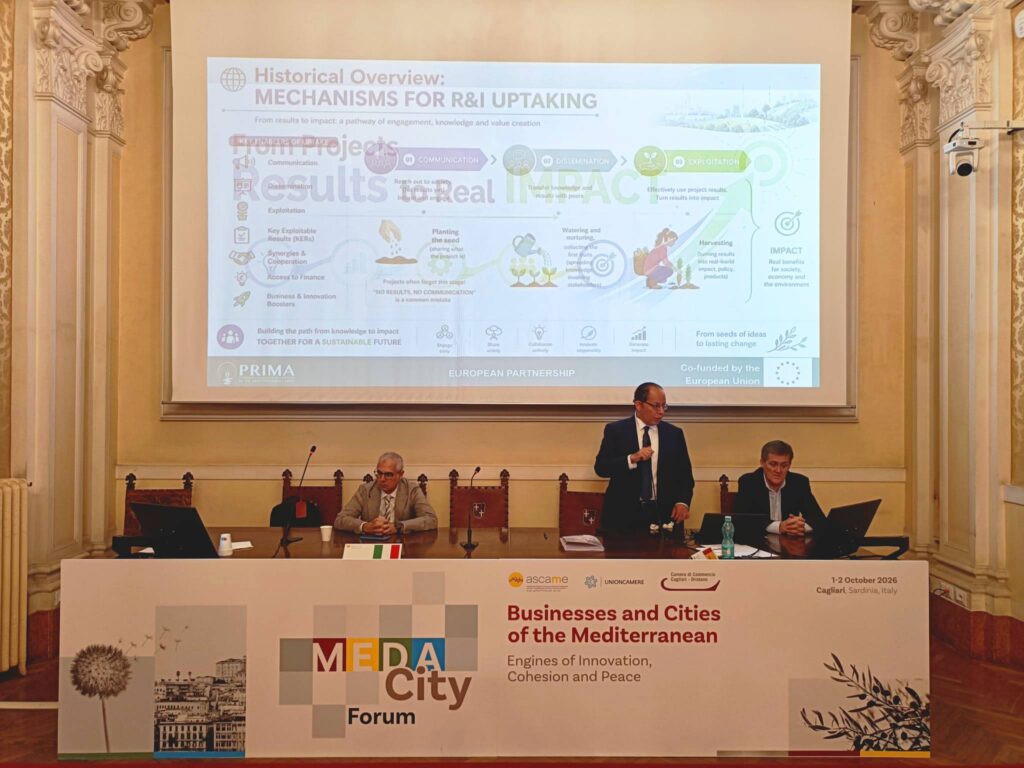
Dr. Mohamed Wageih (PRIMA): The Mediterranean is not a boundary between the two shores, but a bridge of shared destiny and future
A major highlight of the presentation was the announcement of Future4PRIMA (PRIMA 2), a new initiative that will shape the next phase of Euro-Mediterranean research and innovation cooperation. Building on the achievements of the current PRIMA programme, the new call aims to strengthen collaboration among the research and innovation funding bodies of the 16 participating countries while broadening PRIMA’s scope to address emerging challenges across the Mediterranean.
Future4PRIMA promotes a more integrated approach to resource management by expanding cooperation into areas such as ecosystems, energy, and health, while reinforcing its long-standing commitment to sustainable water management and food systems. The initiative also seeks to improve coordination among participating countries, support the scaling up of successful innovations, and create stronger links between research, policy-making, and market uptake.
At its core, PRIMA 2 aims to transform research results into practical solutions capable of delivering lasting benefits for Mediterranean communities. By fostering innovation, cross-border cooperation, and strategic coordination, the initiative seeks to contribute to more water-resilient, sustainable, and competitive agri-food systems across the region. As Mr. Wageih concluded, “the Mediterranean is not a boundary between the two shores, but a bridge of shared destiny and future”.