
Events Ascame/ June 25, 2026/ Ascame members
Establishing an Observatory on Women, Business and Economy in the Mediterranean, modelled on that of the Barcelona Chamber of Commerce, could mark a turning point for equality in the region. The creation of a Mediterranean Observatory would provide comparable data, identify common gaps and enable the sharing of best practices amongst countries with diverse circumstances but similar challenges. Its impact would be twofold- On the one hand, it would provide Chambers of Commerce with a strategic tool to guide business policies and programmes. On the other hand, it would help to accelerate women’s economic participation and leadership, making equality a driver of development for both shores of the Mediterranean.
In this interview, Ms. Carme Poveda, Director of the Observatory on Women, Business and Economy at the Barcelona Chamber of Commerce, analyses how this model could be successfully adapted on both sides of the Mediterranean, whilst also reflecting on the benefits it would bring and the conditions that would enable it to have a truly transformative impact.
The Observatory on Women, Business and the Economy has promoted an inclusive view of the economy and highlighted women’s contribution. What changes has this new perspective – and the evidence of gender inequalities – brought about in the business landscape?
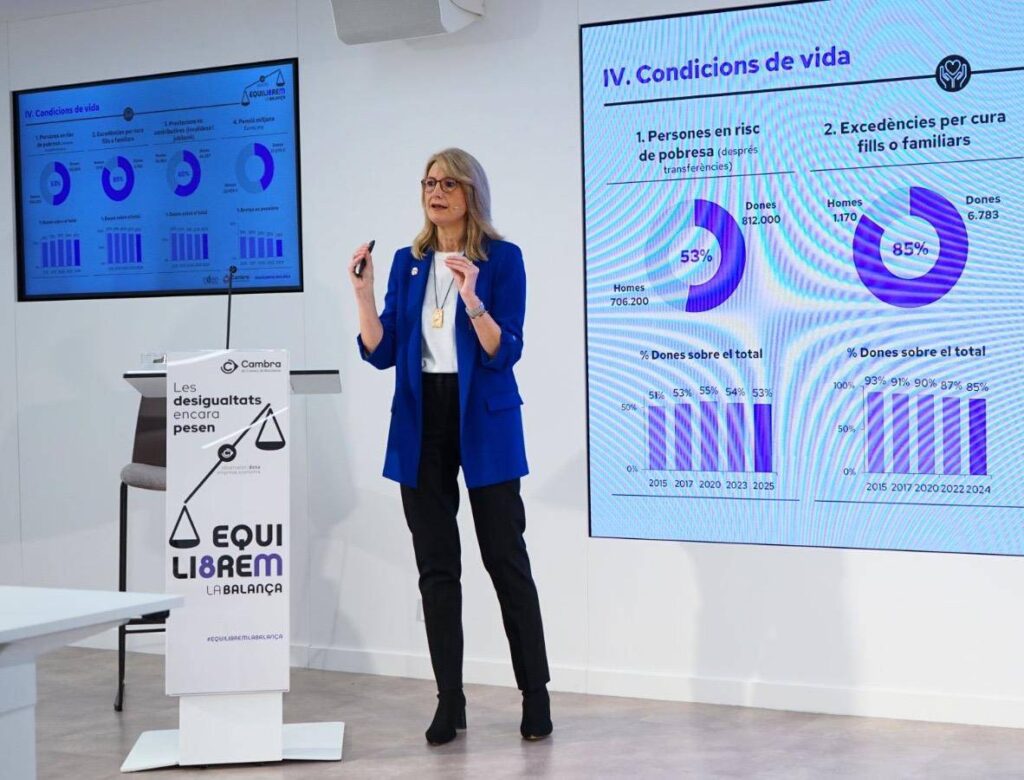
When we set up the Observatory 18 years ago, there was virtually no data available to enable a rigorous analysis of women’s situation in the economy. Our key contribution has been to turn perceptions into evidence and to demonstrate, using economic language, that equality improves business competitiveness. We have developed indicators and methodologies that have brought previously overlooked realities to light, and we have placed issues such as the pay gap, the representation of women on boards, participation in STEM, female entrepreneurship and the impact of care work on the public agenda. Some studies have spurred debate and policy, such as the analysis of the economic impact of a universal network of nursery schools for children aged 0–3, which contributed to the subsequent introduction of free education for the 2–3 age group in Catalonia. As well as generating knowledge, we have promoted specific initiatives to facilitate women’s access to decision-making positions, such as the Platform for Female Board Members and Executives and the School of Equality. We have always sought to combine knowledge, advocacy and action. Our philosophy is that, for equality to add value to a company, it must be integrated into its strategy and decision-making processes, rather than being treated merely as a regulatory obligation.
Despite women’s rising education levels, they remain underrepresented in leadership. You argue that progress depends on strong laws, purpose‑driven companies, and an active civil society. How do these three forces work together to close the leadership gap and advance gender equality?
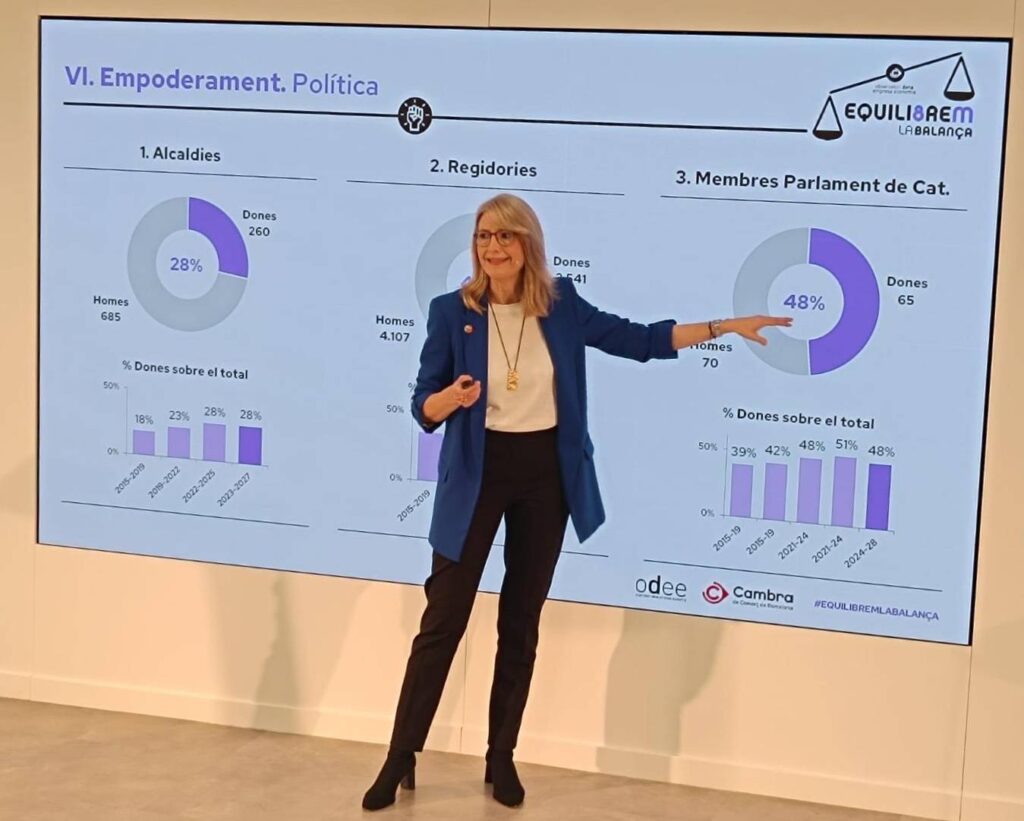
The data reveal a paradox: women make up the majority of university students, but this education does not translate into representation in the arenas where economic decisions are made. To close this gap, action is needed on three fronts. Firstly, the regulatory framework, which has been shown to accelerate change, as evidenced by the increase in the number of women on the boards of listed companies. But legislation alone is not enough: companies must understand that diversity is not just about reputation, but about competitiveness, because diverse teams make better decisions and better reflect society.
Finally, civil society – and, in particular, the Chambers of Commerce – have a key role to play in setting examples, promoting best practice and challenging the stereotypes that hinder progress. True equality is only achieved when institutions, businesses and society move in the same direction.
We face a clear paradox: women lead in education, yet remain absent from many economic decision‑making spaces. Closing this gap requires strong regulation, companies that see diversity as a driver of competitiveness, and a civil society - especially Chambers of Commerce - that challenges stereotypes and promotes best practice. Real equality happens only when institutions, businesses and society move in the same direction
Gender inequalities in the Mediterranean take various forms. What differences do you observe between our country and other Mediterranean countries, and what contrasts exist between the northern and southern shores in terms of opportunities for women?
The Mediterranean region is highly diverse, but common trends can be identified. In the Northern countries, regulatory frameworks are more established, female labour force participation is higher and the presence of women in positions of responsibility has increased, although gaps remain in work-life balance, pay and access to the highest levels of decision-making. In many countries on the Southern shore, women face additional obstacles linked to social norms, difficulties in accessing formal employment, and limitations in accessing finance or developing business projects. Even so, there is great potential: young women who are increasingly well-educated and have higher professional aspirations, as well as many examples of female leadership both in business and in public office, which can help to create models that can be shared with neighbouring countries. Beyond these differences, the entire region faces a common challenge: to make full use of women’s talent. Mediterranean cooperation can be key to exchanging experiences and accelerating progress across all countries.
What role should Chambers of Commerce play in raising awareness amongst businesses about women’s empowerment and highlighting the inequalities that persist?
Chambers of Commerce are in a unique position because they connect businesses, public authorities and civil society. Their role goes beyond simply raising awareness: they can generate knowledge, identify barriers, promote best practice and support businesses in integrating equality as a strategic element of competitiveness. They also act as a voice for the business community, conveying proposals to public decision-makers based on businesses’ real-world experience, which helps to shape more effective policies. The most transformative initiatives combine evidence, training and action. Chambers can therefore play a decisive role in fostering networks of women entrepreneurs and female executives, promoting women’s leadership and generating data to measure progress.
How could the model of the Chamber’s Observatory be adapted to the Mediterranean region as a whole, and what should be the starting point and the main objective?
It is not a question of replicating the Barcelona model exactly, because each country and each chamber operates within different contexts. The key is to apply three useful principles. The first is measurement. What is not measured cannot be improved. The aim is to have rigorous and comparable data, which is essential for understanding where the main gaps lie and how they are evolving. The second is to create spaces for collaboration between businesses, institutions and civil society organisations. Equality is a complex challenge that requires shared responses. And the third is to turn knowledge into action. Studies are important, but they must serve to drive concrete changes within businesses and in public policy. A good starting point would be to create a Mediterranean network of Chambers committed to equality, alongside a common framework of indicators that enables the sharing of assessments and best practices. The ultimate goal should be to build a Mediterranean community of knowledge and action capable of accelerating women’s economic participation and leadership across the region.
The aim isn’t to replicate the Observatory of the Barcelona Chamber of Commerce, but to apply three principles: measure rigorously, collaborate widely and turn knowledge into action. A Mediterranean network of Chambers using shared indicators would help compare progress and spread best practice. The goal is a regional community that accelerates women’s economic participation and leadership
What impact do you think an observatory such as the Chamber’s might have if it were extended to the whole of the Mediterranean, and in which countries might it bring about the most significant changes in the understanding of inequalities and in business policies?
The greatest impact would be to have, for the first time, a shared and comparable overview of the situation of women in the Mediterranean economy. Today, the information exists, but it is fragmented, making it difficult to compare situations across countries. A Mediterranean observatory would make it possible to identify common trends, pinpoint best practices and understand which policies work best. It would also provide chambers of commerce with a strategic tool to guide their programmes and design initiatives tailored to the real needs of their regions. Both northern and southern countries would benefit from comparable indicators that would enable them to assess their current position, track their progress and identify which initiatives are having an impact. The region’s diversity is a strength: sharing knowledge between the two shores can accelerate progress and turn equality into a driver of economic development across the whole of the Mediterranean.
You have pointed out that Artificial Intelligence not only transforms business models, but can also drive more genuine equality. How can AI help to reduce gender gaps, and what specific changes might it bring about in the business and social spheres?
AI will have a profound impact on the labour market and, consequently, on equal opportunities. Our study shows that this transformation is not neutral: women are more exposed to AI because they predominate in administrative, managerial and customer service roles, where many tasks can be automated. However, AI does not replace entire roles, but rather specific tasks, and the challenge is to support this transition so that women and men can adapt on an equal footing. At the same time, AI can transform organisational and leadership models. As technology takes over routine tasks, skills such as analysis, creativity, communication, team management, and the ability to adapt to change become increasingly valuable. Many women have developed these skills throughout their careers, which can strengthen their presence in positions of responsibility. This evolution can also foster more collaborative, cross-functional and people-oriented leadership styles, which are increasingly necessary in complex and changing business environments.
Finally, what signs or trends lead you to believe that the Mediterranean region is moving – or can move – towards greater inclusion of women and genuine equality in all areas? Do we have reason to be optimistic on this issue?
Yes, there are reasons for optimism, although progress requires perseverance. Firstly, Mediterranean women are now better educated than ever before and are gaining a foothold in professional and business spheres that were previously less accessible to them. There is also a growing awareness among institutions and businesses that equality is not just a right, but a factor in development and competitiveness. Another positive trend is the rise in female leadership: more role models, more networks and a greater presence in entrepreneurship, innovation and decision-making forums. Furthermore, Mediterranean cooperation offers a unique opportunity to share experiences and accelerate progress across the region.
However, inequalities persist in labour market participation, leadership, the sharing of caregiving responsibilities and the access to economic opportunities. Progress is not guaranteed and can be reversed in times of crisis. That is why I am optimistic, but also realistic: equality is not automatic, but a collective endeavour that requires commitment and the ability to turn women’s talent into a genuine driver of development for the whole of the Mediterranean.