
Events Ascame/ May 6, 2026/ Featured, Trends
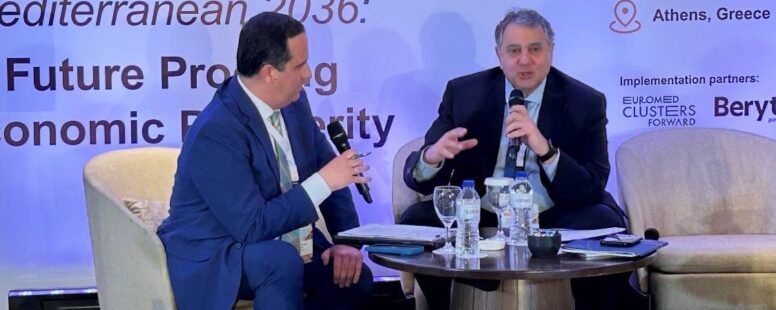
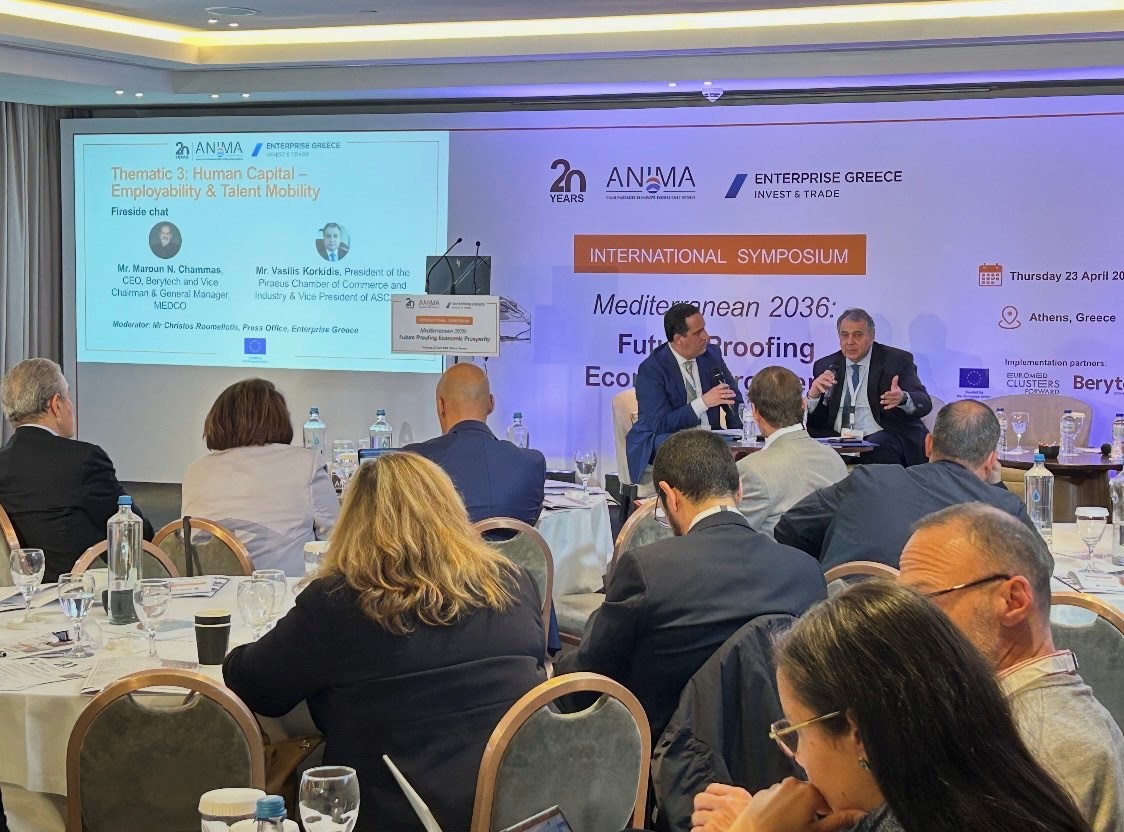
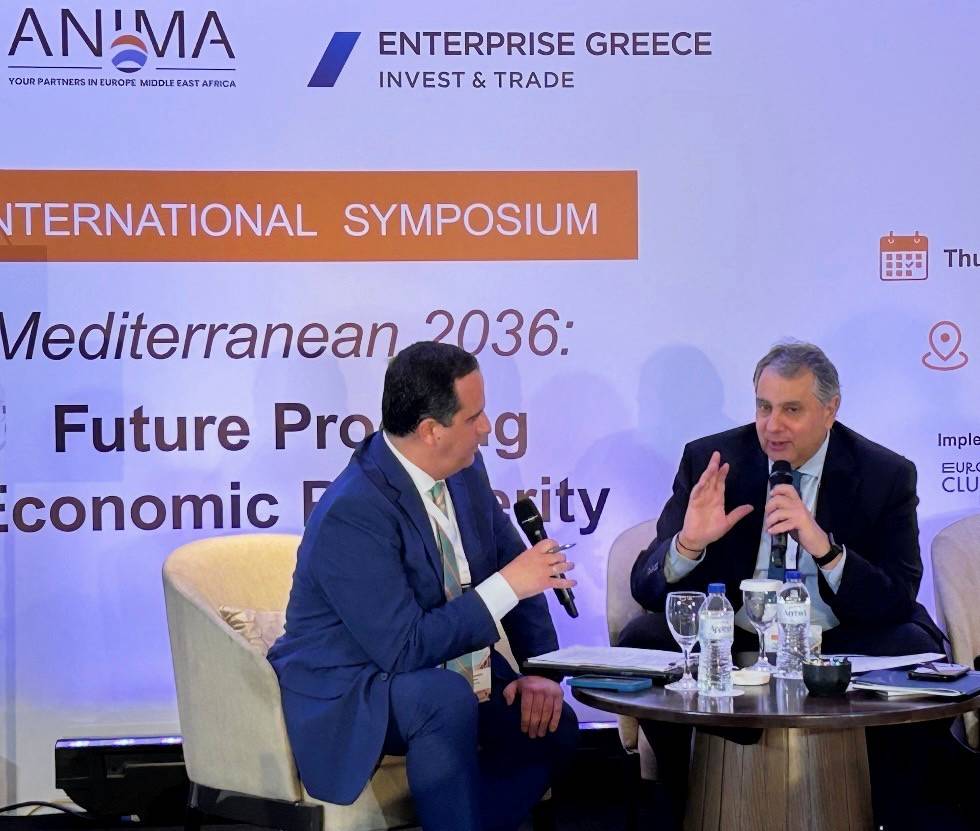
Mr. Vassilis Korkidis, President of the Piraeus Chamber of Commerce and Industry and Vice President of ASCAME, participated in the Euro-Mediterranean Conference – ANIMA 20th Anniversary International Symposium, held in Athens (Greece) on 22-24 April as part of ANIMA’s year-long 20th anniversary program. The summit, focused on shaping a shared economic roadmap for the region through 2036, included a dedicated panel on Mediterranean value chains & economic alliances.
Based on his contribution to the symposium, Mr. Korkidis underscores in this interview that the Mediterranean’s human‑capital challenge lies less in a shortage of skills and more in a systemic failure to harness them effectively. He points to mismatches between education and labour market needs, slow adaptation to technology, and persistent brain drain. Mr. Korkidis also warns that without deep reforms, the region risks remaining stuck in low-value economic models over the next decade. He argues that “brain circulation” is possible but not yet a reality, and that Europe’s role should be supportive but not paternalistic. In his opinion, Chambers of Commerce can play a catalytic role by creating cross-border skill frameworks, training programmes, and real-time labour market bridges.
When we talk about human capital in the Mediterranean, are we facing a lack of skills or a failure of the system?
The reality does not fit into a simple dilemma between “lack of skills” and “failure of the system”. Both phenomena coexist, but the main problem seems to be the inability of economies and institutions to effectively utilise the available human resources. In countries such as Greece, Italy and Spain, there is a constant paradox: high rates of unemployment or underemployment, especially among young people, at the same time that many companies find it difficult to find workers with the right skills. This suggests that the problem is not so much the absolute lack of skills, but rather the mismatch between education and the labour market, the delayed adaptation to technological developments and the outflow of talent abroad. Education systems often emphasise theoretical knowledge, without sufficiently cultivating practical and modern skills, while the connection with production remains weak. At the same time, there are indeed sectors where there is a substantial shortage of skills, mainly in digital fields, technical professions and medium-level specialities that require specialised training. The result is that a large part of human capital either migrates or is underutilised.
In this regard, what worries you most about the next 10 years?
For the next decade, the biggest concern is not just unemployment or technological change, but the risk of trapping Mediterranean economies in a model of low productivity and limited added value. Dependence on sectors such as tourism and low-skilled services makes it difficult to take full advantage of educated workers. At the same time, demographic ageing is reducing the workforce and increasing pressure on social systems, while technological advancements, particularly artificial intelligence, are exacerbating disparities between highly and low-skilled workers. In essence, the most worrying element is that without deep reforms in education, the labour market and the production model, focusing on their interconnection and the formation of the appropriate toolbox, the region risks not only losing talent, but also not being able to make use of what it already has.
From a regional point of view, is unemployment or non-employability the real issue?
The dilemma “unemployment, or non-employability” is not either-or. In the regional analysis, it is usually a combination of the two, but with different severity per region. In weaker or more remote areas, the problem is mainly a lack of jobs, which “translates” into unemployment, due to structural weaknesses of the economy. In more developed or transitional areas, the skills mismatch appears strongly. There are positions, but they are not easily filled. In the short term, unemployment is the most visible and pressing problem (income, social impact). In the long run, unemployability is more critical because it reproduces unemployment, prevents the attraction of investment, and “traps” low-growth regions. In essence, they are not competitive problems, but interrelated. However, in a modern regional policy, the emphasis is increasingly shifted to improving employability (education, skills, adaptability), because this also determines the sustainability of employment.
The problem is not so much the absolute lack of skills, but rather the mismatch between education and the labour market, the delayed adaptation to technological developments and the outflow of talent abroad
Are the education systems in the region not fundamentally aligned with the needs of the market?
The problem is not that education systems are “failing”, but that they are not sufficiently connected, flexible, and oriented to the real needs of the economy. We should not lose sight of the fact that the market is changing rapidly (e.g., digitalisation, green transition), while education systems are adapting slowly due to delays in program renewal, bureaucracy, and limited connection with businesses. If we “x-ray” the market, we will find that there are few “dual education” type systems (education + work), but the most important of them is the lack of participation of employers in the planning of studies. This is an issue that has been demonstrated by the Piraeus Chamber of Commerce and Industry, in the context of the implementation of a special policy for the interconnection of the labour market with the educational system, through a “bridge” between businesses in the Piraeus area and educational institutions of all levels.
Is brain drain still a problem, or should we start seeing it as an opportunity for “brain circulation”? What role can European countries play?
The “brain drain” in the Mediterranean remains a problem, but not in the same way as 10-15 years ago. Today we are in a transitional phase, where it can develop into “brain drain”, but this does not happen automatically, as it requires conditions that often do not yet exist, especially in countries such as Greece, Italy and Spain. because it remains largely one-way. Many young, educated and highly qualified people leave for better pay, more meritocratic environments and more opportunities for advancement, without returning easily. This creates a loss of productive potential, burdens the demographic structure and limits the ability of economies to upgrade technologically. The idea of “brain circulation” is more optimistic and, in some cases, is already starting to emerge. People who leave gain experience, networks and skills abroad and either return or work remotely with their country of origin.
What role can European countries play? Should Europe actively invest in retaining talent in the Middle East and North Africa – or is this unrealistic?
Europe is neither exclusively “guilty” nor automatically a “savior”. The real game is played at the national and regional level, as it is there that it is decided whether the talents will leave permanently, or will return, or will not have to leave at all. European countries act, at the same time, as a magnet that intensifies the problem and as a mechanism that can solve it, depending on the policies implemented. Greece has suffered from a shrinking workforce and a loss of critical skills across the economy. More than 600,000, mostly young, Greeks with a high level of education left between 2010 and 2021, after the country plunged into the most severe recession of any developed economy in peacetime. On the other hand, the idea of the European Union actively investing in retaining talent in countries in the Middle East and North Africa is only realistic under certain conditions. Otherwise, there is a risk that good intentions will remain without result.
The EU has an interest in doing so, because it will reduce the pressures of highly skilled migration, strengthen stability in neighbouring regions and develop markets and partnerships instead of a “drain” of human capital. In other words, it is both a development policy and a geo-economic strategy.
How can Chambers of Commerce and regional networks concretely support skills development across borders?
The Chamber’s role is not just supportive, but catalytic: they can transform a fragmented skills market into a more unified and functional ecosystem. Chambers and regional networks can play a much more essential role than a simple “business intermediary”. That is, they can act as active mechanisms for bridging skills across borders, as long as they move in a targeted manner and not piecemeal. First, they can create common skill frameworks across countries. Secondly, they can develop cross-border training and apprenticeship programmes. Thirdly, they can act as hubs for interfacing with the dispersion. Fourthly, they can make better use of European tools, such as European Union programmes, not just for funding, but for large-scale pilot projects. On this canvas, our Chamber has entered into bilateral cooperation relations with several Chamber bodies in Europe, Asia and Africa with the aim, among other things, to provide bidirectional, continuous information on the needs of the market in real time. This is because they are close to businesses, they have a better picture than the states of which skills are lacking today and which will be needed tomorrow.
Chambers of Commerce can transform a fragmented skills market into a more unified and functional ecosystem. Chambers and regional networks can play a much more essential role than a simple "business intermediary". That is, they can act as active mechanisms for bridging skills across borders, as long as they move in a targeted manner and not piecemeal
If you had to redesign Europe-Middle East and North Africa cooperation on human capital from scratch, what would you change?
Hypothetically. If we were to rebuild it from scratch, we would have to start with a basic reversal. That is, to stop the logic of “education, migration” and replace it with “education, local employment, circular mobility”. The biggest mistake today is fragmentation. Mobility should not be hindered, but planned. And we have all the tools to do that. But it requires political consistency (not piecemeal projects), alignment of the public and private sectors and, above all, patience, because no plan pays off immediately.
What does the Middle East and North Africa expect from Europe, and what should Europe realistically expect in return?
As to what the Middle East expects from Europe, first of all, we need to look at the “relationship” that is being formed. The Europe-Middle East & North Africa (MENA) relationship is deeply interdependent, but also full of asymmetries and suspicion. If we look at it calmly, it is a “negotiation of expectations”, which is not always possible. Many countries in the region, e.g. Egypt, Tunisia, Morocco, expect direct investments in infrastructure, energy and technology, improved access to the European market and the transfer of know-how. Europe is considered a “softer” partner in relation to powers such as China or the United States, and we must take advantage of this element through special policies.

Which human skill will become indispensable by 2035 as AI becomes a core part of work and decision-making?
We are at a stage where AI is developing. So, in the near future, we don’t just need to “know AI,” but we need to be able to work “with it,” as if it’s a tool for thinking and producing. In 2035, probably, the value will not be to know information as AI will do, but for us to design the process on the basis of what is the real issue, and not the obvious, and to judge whether what is presented is correct, appropriate and given that AI makes mistakes – for now – as it has not been perfected at this level. For the misunderstanding. The Mediterranean is in danger of being left in low value-added economies based on tourism and low-skilled services. If this does not change, even educated people will work below their means.
What is one concrete, low-bureaucracy action that institutions should implement in the next two years to accelerate skills mobility?
Chambers and regional networks cannot “solve” the problem of skills as a whole, but they can create operational mechanisms that show a quick result and build a basis for something bigger. The key is to move to things that are low in bureaucracy, high in implementation, and measurable impact. In a 2-year horizon, success will not be judged by grand strategic plans, but by whether operational skills mobility micro-mechanisms are created, which work quickly, have cross-border recognition, and directly link training to real market demand. If these succeed even on a pilot basis, then after 2 years, they can be scaled up to a real regional “skills circulation” system. Success in 10 years will not be the “deterrence of migration”, but the transformation of the Mediterranean into a place where human capital will move easily, will be fairly remunerated, will constantly grow, and return value regardless of where it is located. Many “wills”…