

Events Ascame/ May 4, 2026/ Featured, Trends
The debate on human capital in the Mediterranean is often trapped in a simplistic dilemma. Is it a lack of skills or a failure of the systems? In reality, the picture is much more complex. These two phenomena coexist, but the deeper problem lies in the inability of economies and institutions to make effective use of the already available human resources.
In countries such as Greece, Italy and Spain, there is a constant paradox: high unemployment rates, especially among young people, at the same time that businesses struggle to find workers with the right skills. This phenomenon reveals a deep mismatch between education and the labour market. Education systems continue to emphasise theoretical knowledge, while their connection with production and the real needs of the economy remains limited. At the same time, technological evolution, especially in the areas of digitalisation and Artificial Intelligence, is accelerating changes, which educational institutions find difficult to keep up with.
The result is twofold. On the one hand, businesses are not finding the right staff; on the other hand, a large part of human capital is either underemployed or emigrating. The outflow of talent further exacerbates the problem, depriving economies of critical skills and growth potential.
Looking ahead to the next decade, the biggest challenge is not only unemployment or technological change, but the risk of trapping Mediterranean economies in a low-productivity model. Dependence on sectors, such as tourism and low-skilled services, limits the ability to tap into highly educated workers. At the same time, demographic ageing and a shrinking workforce are intensifying pressures on social and economic systems.
Dependence on sectors, such as tourism and low-skilled services, limits the ability to tap into highly educated workers. At the same time, demographic ageing and a shrinking workforce are intensifying pressures on social and economic systems
At the regional level, the dilemma between unemployment and unemployability also proves to be misleading. In less developed areas, the main problem is the lack of jobs. In contrast, in more dynamic economies, the challenge lies in the skills mismatch. Jobs exist, but they are not filled. In the short term, unemployment is the most visible issue. In the long term, however, unemployability is more critical, as it reproduces inequalities and hinders growth.
At the heart of this equation is the need for a better link between education and the labour market. The limited development of ‘dual education’ systems, low participation of businesses in curriculum design and the slow adaptation of institutions are key obstacles. Without flexibility and cooperation, the gap between skills supply and demand will widen.
At the same time, the issue of “brain drain” remains critical, although it is evolving. While in the past it was mainly a matter of permanent migration, today the prospect of “brain drain” is emerging. That is, the mobility of workers who gain experience abroad and return, or work remotely with their country of origin. However, this transition is not automatic. It requires attractive working conditions, meritocratic environments and real development opportunities.
Europe plays a dual role. It acts both as a talent attraction and as a potential partner to tackle the problem. Strengthening partnerships with countries in the Middle East and North Africa can help create a more balanced skills mobility system. However, such initiatives require coordination, long-term strategy, and mutual trust.
Europe plays a dual role. It acts both as a talent attraction and as a potential partner to tackle the problem. Strengthening partnerships with countries in the Middle East and North Africa can help create a more balanced skills mobility system
Building a new skills ecosystem for the Mediterranean
In this context, the role of the private sector and especially the Chambers emerges as crucial. Chambers and regional networks cannot “solve” the problem of skills as a whole, but they can create operational mechanisms that show a quick result and build a basis for something bigger. However, Chambers can act as bridges between education and the market, contributing to the creation of common skills frameworks, the development of training programs and the strengthening of interconnection with the diaspora. The transition from fragmented actions to long-term partnerships is a key prerequisite for success.
If Europe-Middle East and North Africa cooperation were to be redesigned from scratch, it would have to be based on a new logic: not just education and migration, but education, local employment and circular mobility. Mobility should not be restricted, but planned in a way that benefits all parties. Countries in the region are looking for investment, know-how and market access, while Europe is seeking stability, growth and better management of migration flows.
Finally, as we look to the future, the concept of skill is changing radically. By 2035, the value will lie not so much in information knowledge, but in the ability to understand, think critically, and collaborate with Artificial Intelligence. The challenge will not just be to use the technology, but to evaluate and apply it correctly.

Success for human capital in the Mediterranean will not be measured by preventing migration, but by creating a dynamic ecosystem where people can move, evolve and contribute regardless of geographical location. To achieve this, immediate, practical interventions are needed. Skills mobility mechanisms, closer linkage between education and the market, and policies that enhance the productive utilisation of human resources. Success in 10 years will not be “preventing migration”, but transforming the Mediterranean into an area where human capital moves easily, is paid fairly, grows continuously and returns value regardless of where it is.
The Mediterranean “has talents”. The point is to make the most of it.
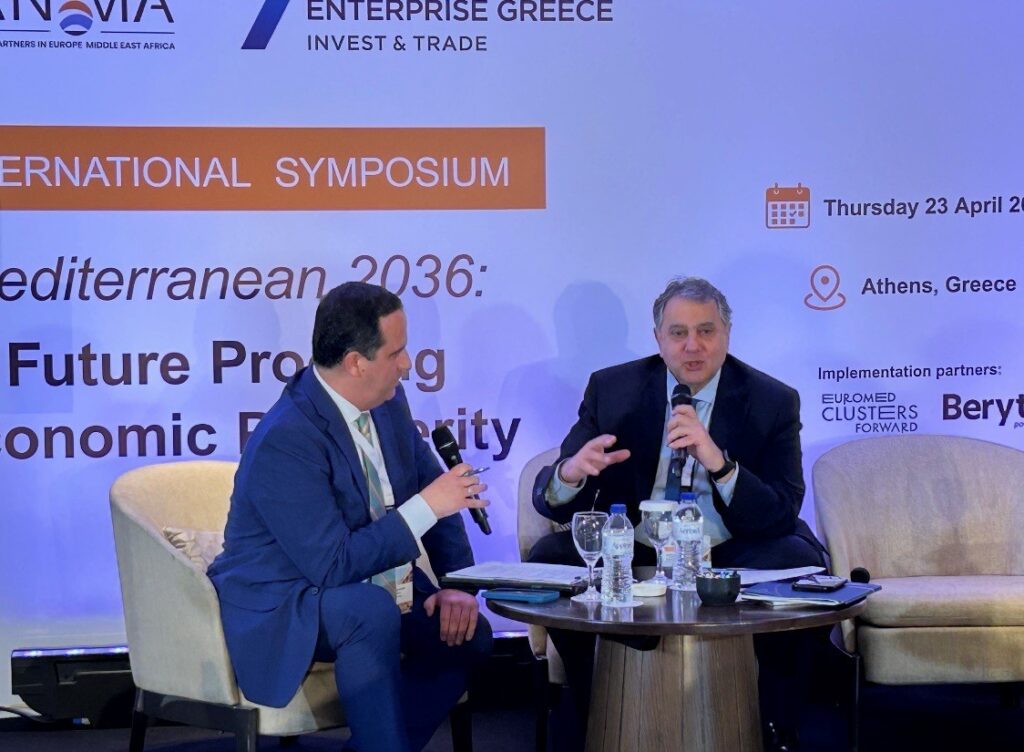
This article, written by Mr. Vassilis Korkidis, President of the Piraeus Chamber of Commerce and Industry, and VP of ASCAME, is based on his recent intervention at the Euro-Mediterranean Conference ANIMA 20th Anniversary International Symposium on the subject “Mediterranean 2036 – Future Proofing Economic Prosperity”.