

Events Ascame/ July 17, 2025/ Featured
A few months ago, ASCAME took a significant step toward accelerating digital innovation in the Mediterranean by signing a strategic collaboration agreement with the Sydney Institute of Technology and Innovation (SITI). Based in Sydney, SITI is a forward-thinking educational institution renowned for its cutting-edge programs in technology, Artificial Intelligence (AI), and digital transformation designed to empower professionals and organizations in a rapidly evolving digital landscape. This partnership was built around two core objectives. First, to fast-track the digital transformation of Chambers of Commerce and businesses across the Mediterranean by harnessing the potential of AI and emerging digital technologies. Second, to drive the growth of the region’s digital economy by making innovation more accessible and impactful.
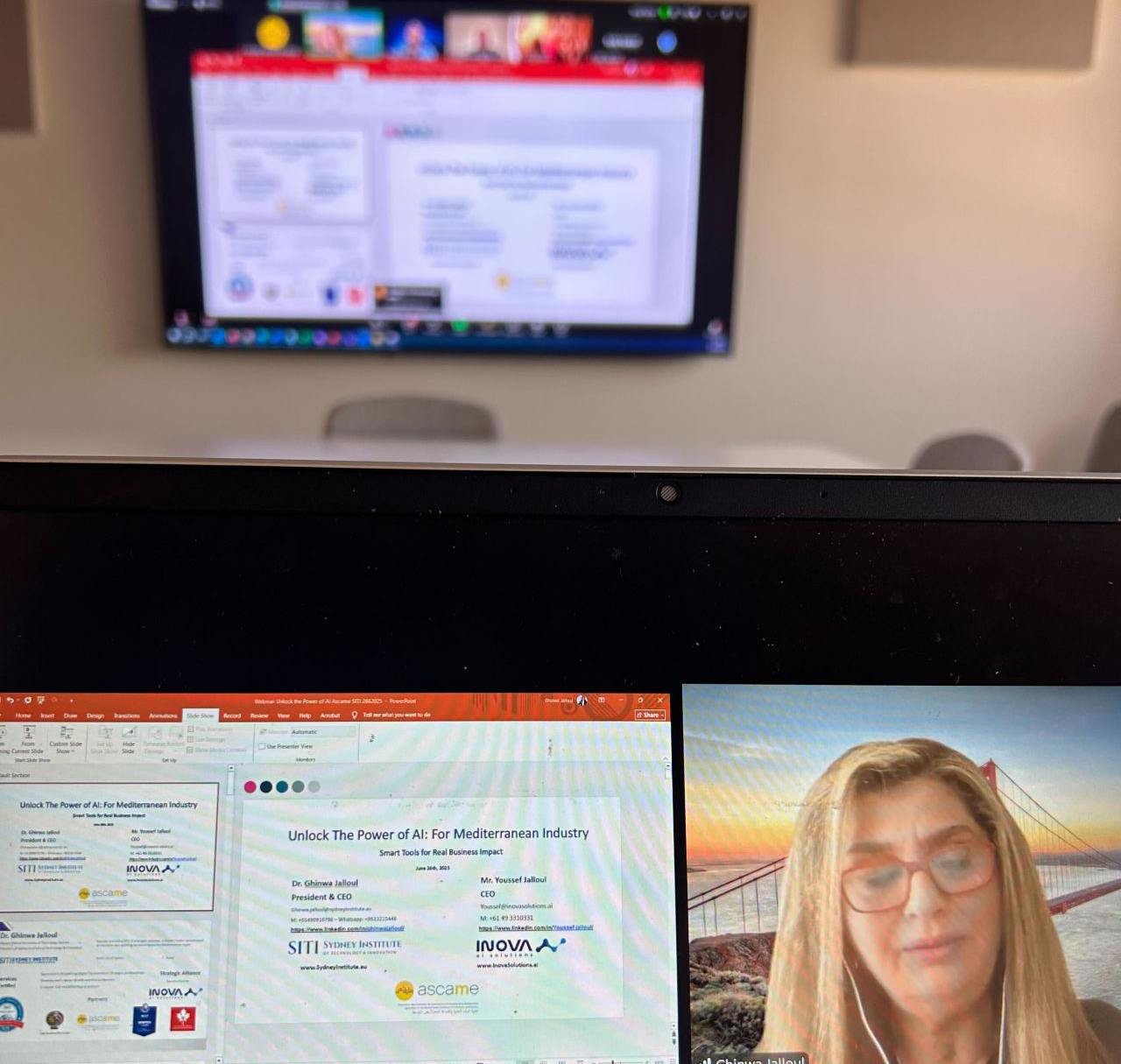
Together, ASCAME and SITI aim to strengthen the Mediterranean private sector, particularly small and medium-sized enterprises (SMEs), entrepreneurs, and professionals, by equipping them with practical digital skills and AI tools. SITI and ASCAME began moving in this shared direction by organizing the joint webinar “Unlock the Power of AI for Mediterranean Industry”, which was a major first step and a practical example of how this partnership can bring real value to chambers, businesses, and professionals across the region. To explore the vision behind this collaboration, we spoke with Dr. Ghinwa Jalloul, President of SITI. In our conversation, she shared her insights on how digitalisation is reshaping businesses, the opportunities it presents for Mediterranean Chambers of Commerce, and the transformative role AI is playing in the region’s organizational landscape.
What strategic objectives does the new agreement with ASCAME aim to achieve?
Through this agreement, we aim to provide Mediterranean Chambers, their members, and all the businesses and professionals they represent with the right knowledge, tools, training, and support to start or expand their AI and digitalisation journey. This means offering practical programs that focus on real business needs—whether it’s using AI to improve customer service, streamline operations, unlock new growth opportunities or inspire innovation. It also includes helping Chambers lead by example and become digital champions in their own communities. We understand that many small and medium-sized enterprises are ready for the AI-driven digital transformation, but often face challenges in knowing where to start or accessing the right tools. That’s why we focus on providing practical, hands-on programs that empower businesses to integrate AI into their core operations, leading to improved customer experience, reduced costs, and enhanced decision-making.
What kinds of solutions and services will you offer to Chambers of Commerce, businesses, and professionals?
Key ways SITI provides support include:
- Custom-designed upskilling and reskilling programs that equip Chambers staff and business leaders with essential competencies in AI, data literacy, digital strategy, ethical and responsible AI use.
- AI implementation roadmaps to help Chambers and companies assess their current state, identify high-impact use cases, and prioritize areas for digitization and AI integration.
- Hands-on exposure and access to AI tools and no-code solutions with Agentic AI, empowering organizations to integrate intelligent automation, customer insights, and process optimization without requiring technical expertise.
- Capacity building for digital leadership, enabling Chambers to act as regional champions for AI adoption by demonstrating success stories and guiding local SMEs.
- Collaborative workshops, pilots, and technical assistance, where SITI partners directly with Chambers to explore AI applications relevant to their sector —such as smart trade facilitation, e-governance, logistics, manufacturing, or digital marketing. Ethical AI governance frameworks and policy templates, helping institutions embed responsible and transparent AI practices into their strategic operations.
Beyond technical skills, we aim to empower entrepreneurs and help local leaders unlock new possibilities for their businesses and communities. Through our training, we seek not only to build capacity but also to inspire innovation—encouraging a forward-looking mindset that sees AI not as a threat, but as a tool for growth. Through these actions, SITI empowers Chambers of Commerce not only to transform their own operations, but also to lead digital adoption within their networks —positioning themselves as catalysts for innovation and sustainable economic growth in the Mediterranean.
SITI empowers Chambers of Commerce not only to transform their own operations, but also to lead digital adoption within their networks —positioning themselves as catalysts for innovation and sustainable economic growth in the Mediterranean

Why is it urgent for Mediterranean Chambers of Commerce and SMEs to embrace digital transformation now?
We are no longer preparing for a digital future—we are already in it. The launch of ChatGPT in 2022 and the rapid rise of generative AI have opened the doors wide to the era of AI democratization—AI for All. What this means is that, for the first time in history, advanced technologies are truly within reach of all businesses, regardless of size or location. The global opportunity is massive. Recent studies estimate that AI will generate USD 246 billion in additional revenue by 2030 in the Mediterranean region and 15.7 trillion to the global economy. But let’s be clear: this wealth will not be evenly distributed. It will go to those who know how to adopt AI correctly and effectively in their operations.
A recent global study involving 1,363 professionals from across industries showed that proper AI adoption led to 30–45% cost reductions and up to 34% revenue growth. These are not future projections—they’re real, measurable gains happening today. This is why Mediterranean Chambers of Commerce and SMEs must act now. SMEs want to adopt AI, but they face real challenges: lack of skills, fear of risk, and limited guidance. Chambers can be the bridge by leading and supporting their members through this transformation, offering credible training, and helping them avoid common pitfalls.
How is AI reshaping the business landscape and the global economy?
AI is reshaping the global economy at an unprecedented pace. According to PwC, AI is expected to contribute up to USD 15.7 trillion to the global economy by 2030, with USD 6.6 trillion from increased productivity and USD 9.1 trillion from consumption effects. McKinsey’s 2023 global AI survey found that early adopters are already seeing 30–45% reductions in operating costs and up to 34% increases in revenues. AI is transforming how businesses operate—automating tasks, personalizing customer experiences, enhancing supply chains, and supporting decision-making with real-time data. From agriculture to healthcare, education to logistics, AI is no longer a luxury— it is a defining factor of global competitiveness. But perhaps most importantly, it is also changing the skill sets required for work and business operations. Employees now need to understand how to work alongside intelligent systems, and business leaders must know how to use AI tools to make smarter, faster decisions. The Mediterranean is rich in human capital, entrepreneurial energy, and sectoral strengths. SMEs represent more than 95% of all businesses and account for many jobs across the region. Key sectors such as tourism, agriculture, manufacturing, logistics, and trade are highly relevant for AI-driven transformation. Additionally, the region is home to a growing generation of tech-savvy youth and emerging startup ecosystems in cities like Barcelona, Istanbul, Tunis, and Beirut. If the Mediterranean embraces AI strategically—investing in skills, ethics, and applied innovation— it can leapfrog traditional development paths and emerge as a vibrant, digitally integrated region that bridges Europe, Africa, and the Middle East. But time is an essential factor.
SMEs want to adopt AI, but they face real challenges, such as the lack of skills, fear of risk, and limited guidance. Chambers can be the bridge by leading and supporting their members through this transformation, offering credible training, and helping them avoid common pitfalls

What industries have been reshaped by AI in the Mediterranean? Which industries currently offer the most growth opportunities?
AI is beginning to reshape several key industries across the Mediterranean—especially those that are data-rich, service-driven, or logistics-intensive. Tourism, a cornerstone of many Mediterranean economies, has been one of the first to embrace AI. Hotels, travel agencies, and platforms are using AI to personalize guest experiences, manage dynamic pricing, and analyze traveler behavior to boost occupancy and customer satisfaction. In agriculture, AI is transforming traditional farming through precision agriculture—using sensors, drones, and AI-driven analytics to optimize water use, detect crop diseases early, and improve yield forecasts.
Retail and e-commerce are also undergoing major changes. Businesses are using AI to personalize shopping experiences, optimize supply chains, manage inventory more efficiently, and target marketing more accurately —unlocking growth for local producers and cross-border trade. Healthcare is seeing early adoption of AI for diagnostics, patient triage, and operational efficiency. Logistics and ports, vital to Mediterranean trade, are starting to integrate AI for route optimization, customs automation, and predictive maintenance of fleets, helping reduce costs and delays. Looking ahead, the industries with the most growth potential are those at the intersection of digital services, green innovation, and regional integration. In short, AI is not just reshaping industries—it’s redefining where future growth will come from. Mediterranean businesses and Chambers that invest in these opportunities now will be the leading regional innovation and global competitiveness tomorrow.
If the Mediterranean embraces AI strategically -investing in skills, ethics, and applied innovation- it can leapfrog traditional development paths and emerge as a vibrant, digitally integrated region that bridges Europe, Africa, and the Middle East. Time is an essential factor
What are the potential and limitations of the digital revolution, and how might it transform the Mediterranean landscape in the coming years?
The digital revolution holds enormous potential for the Mediterranean. It offers the chance to bridge long-standing economic gaps, create new value chains, and connect the region more deeply to global markets. For a region rich in human capital, creativity, and entrepreneurial spirit, digital technologies —especially AI, cloud platforms, and data analytics— can unlock new possibilities in trade, tourism, manufacturing, agriculture, and services. Digitally enabled SMEs can expand beyond borders. Governments can deliver better services at lower costs. Youth can access global job markets through remote work. And entire sectors—like agri-food, logistics, and education—can become more productive, inclusive, and sustainable. However, the limitations are equally real. The region faces deep digital divides—between countries, between urban and rural areas, and between large corporations and small businesses. Access to digital infrastructure, limited investment, outdated regulations, and a critical shortage of digital and AI skills are holding back progress.

Many Mediterranean economies are still at the early stages of digital transformation, and without coordinated action, the gap will only grow wider. Over the next decade, the digital revolution could reshape the Mediterranean into a more competitive, interconnected, and innovation-driven region—but only if the right investments are made today. This includes upskilling the workforce, supporting SMEs with the tools and knowledge to digitalize, building digital infrastructure, and crafting smart, ethical policies that guide AI and data use. The future of the Mediterranean will not be decided by technology alone—but by how boldly and inclusively the region chooses to embrace it.