

Events Ascame/ February 27, 2025/ Featured
In some cultures, the idea of an Artificial Intelligence (AI)-powered assistant managing finances, healthcare, or even personal relationships is embraced with enthusiasm. In others, the thought sparks deep skepticism. This divide highlights a fundamental truth: AI isn’t just a technological revolution; it’s a cultural revolution.
When OpenAI launched ChatGPT-3.5 in November 2022, it ignited global conversations about AI’s potential to reshape work, creativity, and even societal structures. Experts and visionaires speculated about the ‘universal high income’ replacing traditional jobs, an idea met with starkly different reactions around the world. Now, in February 2025, a new player enters the scene —DeepSeek-R1, an advanced chatbot developed in China, reflecting a distinct approach to AI shaped by different cultural values and priorities. As Artificial Intelligence continues to evolve, at the dawn of the Fifth Industrial Revolution (5IR), which encompasses the concept of harmonious human-machine collaboration, a pressing question arises: How does culture influence our development, trust, and integration of artificial intelligence into our daily lives?
AI is transforming industries, but its adoption and development vary greatly across cultures. Two of the most influential players in AI -OpenAI in the United States and DeepSeek in China- approach the technology differently, shaped by their cultural values and economic strategies. AI development in the United States is driven by innovation, individualism, and a startup culture. Companies prioritize short-term breakthroughs and rapid scaling, often funded by venture capital. The focus is on agility, first-mover advantage, and quick returns on investment. In contrast, China’s AI adoption follows a government-led strategy, emphasizing a collective mindset and large-scale implementation.

Businesses in China operate with a long-term vision, aligning AI development with national policies and long-term economic planning. These differences shape how AI impacts workforce development, education, and leadership. While the United States emphasizes quick skill acquisition and disruptive innovation, China invests in large-scale AI education and national AI strategies that ensure gradual, sustained growth.
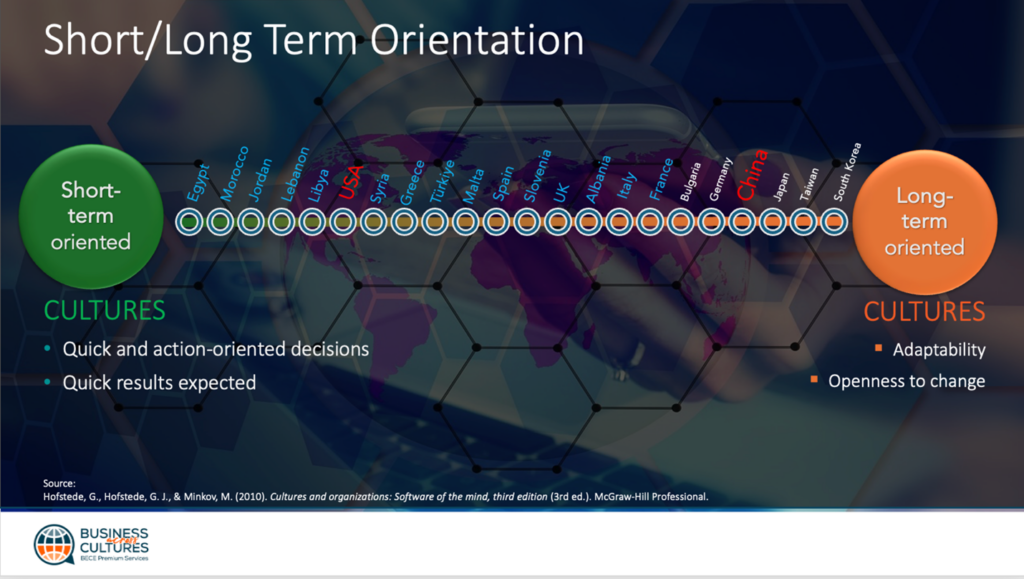
Why Long-Term Orientation (LTO) matters for businesses?
Hofstede’s Long-Term Orientation (LTO) is a key cultural factor that significantly impacts AI strategies. Companies that grasp this dimension can make well-informed decisions regarding their workforce, investments, and expansion plans. In the case of China we should talk about LTO strategies: Businesses prioritize long-term gains, patient investment, and gradual innovation. AI is viewed as a strategic, multi-decade initiative integrated into economic and social planning. On the contrary, in U.S. we should refer to a short-term oriented culture: Companies focus on short-term results, rapid innovation cycles, and immediate ROI. While this approach can lead to groundbreaking advancements, it also increases market volatility.
Regarding the decision-making & risk-taking there are also differences. Within Long-Term Oriented cultures, such as China and Japan, businesses adopt a more pragmatic and future-oriented decision-making approach. They take a measured approach, ensuring that AI technologies mature before full implementation. On the other hand, in short term cultures, such as the U.S. and the UK, businesses tend to be more risk-taking and short-term results driven. The focus on immediate impact accelerates AI innovation, but it can also lead to frequent pivots and failures.
Implications for Future Developments & Current Decisions
For global businesses, companies must adapt their AI strategies based on their cultural orientation. In addition, expanding into long-term oriented markets (e.g., China) requires patience and a long-term vision. Success in short-term markets (e.g., the U.S.) often depends on speed, agility, and rapid adaptation. Multinational corporations (MNCs) must strike a balance between short-term profits and long-term stability when investing in AI, hiring global talent, and training employees.
For individuals and organizations, the future lies in developing future-proof skills such as communication, cultural intelligence, and adaptability, which will become increasingly valuable over short-term technical trends. Professionals should focus on acquiring AI-proof skills, including critical thinking, leadership, and intercultural collaboration.
Organizations like BÉCÉ Consulting & Language Services can play a crucial role in bridging cultural gaps and fostering effective adoption of AI in business strategies. BÉCÉ Consulting & Language Services provides companies with a strategic partner to navigate the transformative landscape of AI-driven business. Here’s how we assist:

- Bridging the AI-Human Gap: Future-Proof Communication Skills. AI is reshaping job roles, but human skills like leadership, collaboration, and problem-solving remain irreplaceable. BÉCÉ helps professionals develop adaptability, strategic thinking, and effective communication to thrive alongside AI.
- Navigating Cultural Differences in AI & Business: AI adoption strategies vary across cultures (e.g., the fast-paced approach in the U.S. compared to China’s long-term planning). BÉCÉ offers intercultural training to enhance global team collaboration, reducing friction and improving efficiency.
- AI & Language: Ensuring precision in global communication. In today’s interconnected world, ensuring precision in global communication is paramount. BÉCÉ provides expertise in language translation, interpretation, and cultural sensitivity, helping companies communicate effectively across diverse cultures.
In today’s rapidly evolving world of AI, businesses must navigate the challenges and opportunities it presents with strategic thinking. While AI tools like machine translation and chatbots can streamline communication, they still require human oversight for accuracy and cultural appropriateness. To effectively leverage AI in the workplace, businesses need to focus on developing their workforce’s language proficiency and cultural awareness. This can be achieved through coaching and training programs that empower managers and employees to adapt, lead, and thrive in an AI-driven environment.
In conclusion, the future of AI and cultural intelligence lies in the ability of businesses to strike a balance between short-term gains and long-term sustainability. By investing in their workforce’s development and leveraging AI tools effectively, businesses can navigate the challenges and opportunities presented by this transformative technology.
Post written by Ms. Elisabet Camprubí, and CEO of BÉCÉ Consulting & Language Services, one of ASCAME’s partners, and Ms. Steffi Necheva, Intercultural Management Consultant. Contact us if you are interested in taking advantage of the collaboration agreement between ASCAME and BÉCÉ and increasing your company’s competitiveness in a multicultural environment! 👉 secretariat@ascame.org