
Oscar Maronda/ November 5, 2026/ Events, Featured
The second panel of MedaCity 2026, entitled “Tourism and Urban Identity: Managing Tourism without Losing the Identity of Cities”, explored how cities can balance urban development and tourism growth while preserving their unique identity and cultural heritage. The discussion served as a valuable opportunity to share experiences, best practices and innovative models aimed at promoting more sustainable, inclusive and responsible tourism across Mediterranean cities.
The session opened with a keynote address by Dr. Joan Clos, Former Mayor of Barcelona and Former Executive Director of UN-Habitat, who highlighted the strategic role of Mediterranean cities as engines of development, prosperity and transformation. He argued that the Mediterranean should be understood as a highly interconnected urban region, where cities are not only centres of population but also key drivers of economic growth, innovation and sustainable development, in line with the objectives of SDG 11 and the New Urban Agenda.
A central idea of his presentation was the need to move beyond the traditional concept of individual cities and adopt the perspective of Functional Urban Areas (FUAs), which integrate cities with their surrounding municipalities through economic activity, mobility flows and labour markets.
Dr. Clos also highlighted the importance of the Mediterranean’s network of port cities, stressing the strong connection between cities, ports, trade, jobs and regional development. He presented the Mediterranean as a space of multiple interconnected urban and logistical systems, where cooperation between territories can generate economic opportunities and strengthen regional integration.
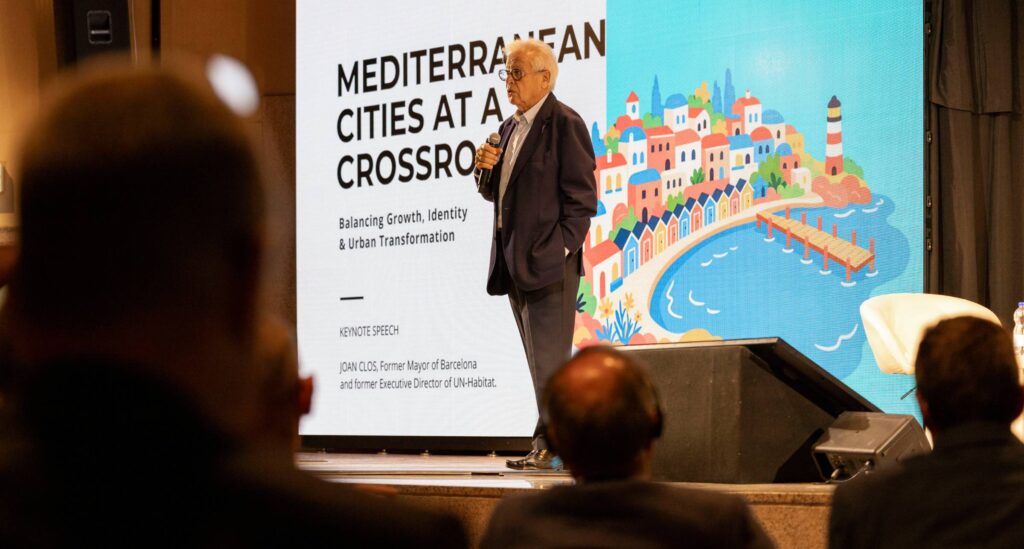
At the same time, he warned that the major challenges facing the region, including urban growth, financing, energy, water management, human capital, environmental sustainability and peace, transcend municipal and national borders. Addressing them therefore requires a stronger culture of cooperation among Mediterranean cities and countries. In his words, the objective should be to move “from the sea that separates to a region that connects”.
Finally, Dr. Clos emphasised the complementarity between the northern and southern shores of the Mediterranean. While the North seeks investment, development and support for the energy transition, the South offers a young population, renewable energy potential and significant economic opportunities. Strengthening connections between cities, ports, people, knowledge and businesses is therefore essential for building a more prosperous, integrated and resilient Mediterranean region.
Strengthening connections between cities, ports, people, knowledge and businesses is essential for building a more prosperous, integrated and resilient Mediterranean region
Urban identity as a driver of sustainable tourism: The case of Cap Bon
Building on these reflections, Mr. Moez Hassen, Director General of the Chamber of Commerce and Industry of Cap Bon (Tunisia) and a member of ASCAME, presented the case of the Tunisian region of Cap Bon, highlighting the challenge of balancing tourism growth with preserving local identity. He highlighted Hammamet, one of Tunisia’s leading tourism destinations, where sustained tourism growth and urban expansion have made it increasingly important to preserve the cultural and territorial identity that distinguishes the region.
He also underlined the need to diversify the tourism offer beyond the traditional coastal model by investing in experiential tourism, creative industries, agritourism, gastronomy, and cultural routes. In this regard, Cap Bon has emerged as what he described as an “open-air laboratory” for sustainable tourism, supported by local stakeholders, European-funded projects, and strong community engagement. The region’s ambition to become a World Gastronomy Region in 2028 reflects this strategy of using local traditions and products as drivers of economic development.
A central theme of his intervention was local communities’ role in shaping tourism development. Hassen emphasized that sustainable tourism must create opportunities for residents, particularly young people and women, through entrepreneurship, artisan crafts, eco-tourism initiatives, and the promotion of local value chains. He argued that preserving identity is not about freezing cities and territories in the past, but about transforming cultural heritage into a living economic asset that generates jobs, innovation, and social cohesion.
In conclusion, Mr Hassen underlined that tourism should not be seen as a threat to local identity, but as an opportunity to enhance it. Supported by innovation, digitalisation, strong governance and public-private partnerships, tourism can become a catalyst for sustainable growth while preserving the cultural and territorial distinctiveness of Mediterranean destinations.
Sustainable tourism must create opportunities for residents, particularly young people and women, through entrepreneurship, artisan crafts, eco-tourism initiatives, and the promotion
of local value chains
Traditional Markets: Guardians of urban identity and cultural heritage
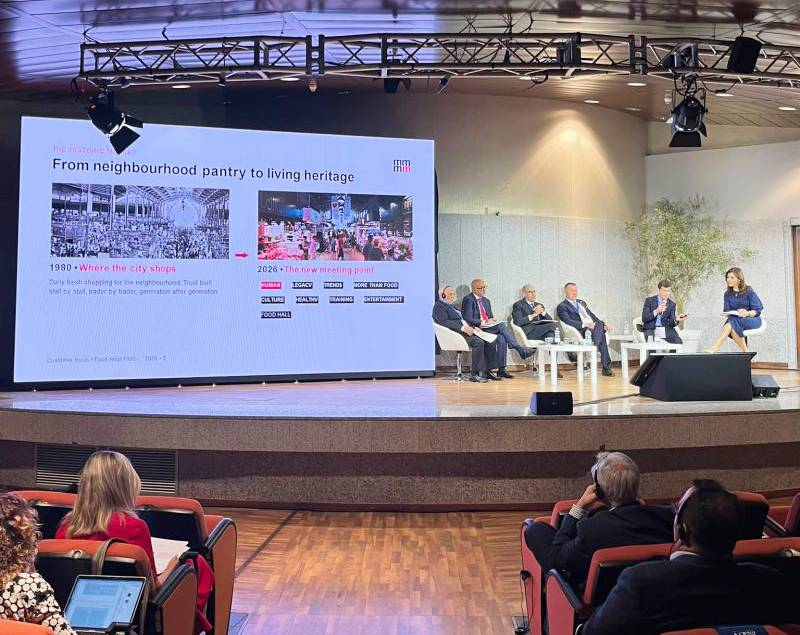
Another of the key themes of the session was the importance of traditional markets in preserving the authenticity and cultural character of cities. In this regard, Mr. Jordi Mas Velasco, President of Barcelona’s iconic La Boqueria Market, stressed that markets are much more than commercial spaces: “they are places where a city tells its story and expresses its identity”. To him, “markets are becoming the new meeting points where residents and visitors alike can experience the authentic soul of a city”.
Speakers highlighted the need to connect markets without standardising them. Cooperation should focus on exchanging knowledge and good practices in areas such as digitalisation, sustainability, tourism management, customer experience and generational renewal. They also called for joint research, exchanges between market managers and traders, and shared cultural initiatives linking Europe’s most emblematic markets. The ultimate goal is to strengthen the recognition of markets as living cultural heritage, with Southern Mediterranean markets playing a key role in shaping this model.
In addition, Mr. Said DOR, President of the Chamber of Commerce, Industry and Services of Agadir-Souss Massa, and a member of ASCAME, referred to Agadir’s traditional bazaar as a symbol of the city’s identity and resilience. He recalled that Agadir was almost destroyed by the devastating earthquake of 1960 and later rebuilt while maintaining its cultural roots. According to Mr. DOR, the city has successfully balanced modernisation with the preservation of its identity, reflecting Morocco’s multicultural heritage. Looking ahead, he stressed that Agadir intends to capitalise on the opportunities created by the 2030 FIFA World Cup, which Morocco will co-host with Spain and Portugal, using the event to showcase the city’s culture, markets and unique history.
Markets are places where a city tells its story and expresses its identity. They are becoming
the new meeting points where residents and visitors alike can experience the authentic soul
of a city
Towards a Mediterranean standard for sustainable and identity-based tourism
Building on the examples of cities and markets as guardians of local identity, Mr. Maurizio Battelli, Founder and President of Associazione EXTRA, introduced the MedLux Standard, the first Mediterranean standard for sustainable luxury vacation rentals. The initiative seeks to link luxury tourism with territorial identity through five certifiable pillars: vernacular architecture, local artisan supply chains, authentic cultural experiences, environmental stewardship and measurable social impact for local communities. To guarantee transparency and accountability, the standard is supported by independent mystery-guest audits and a shared data observatory.
Mr. Battelli explained that the model is designed to be replicated across the Mediterranean through a strong focus on training and certification of the entire local value chain, from builders and renovators to property managers. Having already been tested in Sardinia, the project now aims to create a Mediterranean consortium involving Chambers of Commerce, research institutions and tourism stakeholders from both shores of the region. As he concluded, the Mediterranean has the capacity to define and certify its own standards of quality and sustainability, rather than relying on models developed elsewhere.